Opal kitchen glass · Corning, 1915-1998 (US)
Vintage Pyrex
Pattern names are search terms, gloss is the money signal, and the same bowl can be $8 or $80 depending on both.
Pyrex begins with a casserole that started life as a battery jar. In 1913, Bessie Littleton, whose husband was a Corning Glass Works scientist, baked a sponge cake in a sawed-off jar of the company's tough new borosilicate glass, developed so railroad lantern lenses wouldn't shatter in the rain. The cake came out clean, Corning saw a market, and in 1915 Pyrex bakeware went on sale: laboratory glass for the American kitchen.

Act I1947: color hits the kitchen
For thirty years Pyrex meant clear glass. After the war, Corning switched on something new: opal ware (opaque white glass in cheerful colors), starting with the red-yellow-green-blue Primary Colors mixing bowl sets. It landed in the same postwar kitchens as chrome dinettes and Formica, and it was marketed the same way: not equipment, but decor you cook with.
Act IIPatterns became a language
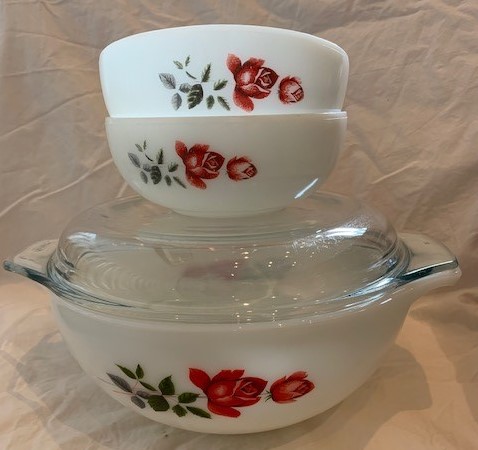
From the mid-1950s Corning issued named patterns the way Detroit issued model years: Butterprint's Amish farmer couple, Gooseberry (the pink version is the one collectors fight over), Snowflake, Pink Daisy, and dozens of promotional pieces sold only for a season. Those names are now the entire market vocabulary. Nobody searches "old white bowl with flowers." Collectors search "Butterprint Cinderella set," and if you can't name the pattern, you can't price the bowl.
Act IIIThe gloss religion
US production of opal Pyrex ended in the late 1990s, and the collector market that grew up afterward developed one hard rule: gloss is grade. A trip through the dishwasher strips the fired-on color to a dull, chalky finish (collectors call it DWD, dishwasher damage), and it cannot be reversed. The same Gooseberry bowl is worth several times more shiny than dull, which makes a ten-second tilt under the light the single most profitable move in the housewares aisle.
Act IVWhy it keeps selling
Pyrex collectors skew younger than china collectors because the appeal is usable nostalgia: display it on open shelving Monday, bake in it Thursday. Buyers complete sets (the 400-series bowl run, fridgies with their glass lids), so singles feed a constant demand. It's heavy to ship, but it survives shipping, and the Facebook-group culture around patterns keeps prices legible and liquid.
Named patterns (pink Gooseberry, Butterprint, promos), complete sets and lids, factory gloss, and a kitchen childhood they can put back on the shelf.
Pattern completists, set-builders, retro kitchen decorators, wedding-gift nostalgists, and everyday cooks who just want the good old stuff.
Name the pattern, tilt it under light. Glossy named-pattern pieces at $2-5 are the most reliable flip in the kitchen aisle; dull ones are decor, not inventory.
Sources: Corning Museum of Glass: Pyrex collection · Corning Museum of Glass: The Beginning of Pyrex · Corning Museum of Glass: A Century of Pyrex
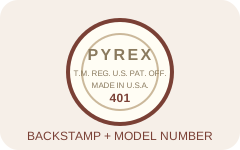 Backstamp + model number
Flip it. The PYREX stamp plus a model number (401-404 for the mixing bowl run) confirms it's real and tells you what set it belongs to. "Made in U.S.A." puts it in the vintage era.
 Name the pattern
Butterprint, Gooseberry, Snowflake, Pink Daisy, promos. The pattern name is the search term and the price. Pink and turquoise pieces carry a premium. Photo via Wikimedia Commons (Melissa Highton, CC BY-SA 4.0).
The gloss test (DWD)Tilt it under strong light. Factory gloss shines like new; dishwasher damage looks chalky and dull and can't be fixed. Also check rim chips and utensil marks inside bowls. Photo via Wikimedia Commons (Melissa Highton, CC BY-SA 4.0).
- Flip it: PYREX backstamp and model number.
- Name the pattern: if you can't, photograph and look it up.
- Tilt under light: glossy or dishwasher-dulled?
- Run a finger around the rim: chips and flea bites.
- Lids: fridgies and casseroles need their glass lids.
- Sets beat singles: grab the whole stack if it's priced right.
Measuring cups, pie plates: usable, common.
Spring Blossom, Snowflake Garland, Old Orchard: glossy, no chips.
Primary Colors or patterned 401-404 runs, complete and glossy.
Butterprint, Gooseberry (especially pink), Pink Daisy: glossy.
With their glass lids, lids uncracked.
A pattern you can't name, unusual shapes, promotional pieces.
- Dishwasher-dulled finish at collector prices: it can't be restored.
- Rim chips, cracks, or deep utensil scratching inside.
- Fridgies or casseroles missing lids but priced as complete.
- Modern clear Pyrex priced as vintage opal ware.
Questions collectors ask
How can you spot dishwasher damage on vintage Pyrex?
Compare the painted surface with protected areas near rims or handles. A dull, chalky, faded, or rough finish suggests lost factory gloss and should lower the ceiling.
Does a Pyrex backstamp identify the exact pattern and value?
No. The stamp helps date and size the shape, but pattern, color, finish, condition, lid, and set completeness still need separate identification.
Do lids and cradles matter with vintage Pyrex?
Yes. Correct lids, handles, cradles, and complete nesting sets can improve demand. Check each accessory for the right size, damage, and model match.
Link disclosure: eBay links currently open ordinary sold-search results. If a link becomes commission-earning in the future, it will be clearly identified near the link.
Marker images mix real examples (credited, via Wikimedia Commons) and hand-drawn diagrams. Prices reflect eBay sold ranges as of July 2026.