Portable sewing machine · Singer, 1933-1960s
Singer Featherweight
Eleven pounds, one perfect straight stitch, and ninety years of quilters who refuse to sew on anything else.
Singer unveiled the Featherweight 221 at the 1933 Century of Progress World's Fair in Chicago: a full-function sewing machine in cast aluminum, eleven pounds where household machines ran forty, with a flip-up extension bed and a suitcase it disappeared into. In the middle of the Depression, Singer bet that women wanted a serious machine they could carry (to a sewing circle, a class, the kitchen table), and won for thirty years straight.

Act IBorn portable
The idea wasn't entirely Singer's. The Standard Sewing Machine Company's little "Sewhandy" proved a portable could work; Singer answered with the 221 and out-engineered everyone: a rotary hook, precision gears, and a straight stitch so consistent that machines ninety years old still sew show-quality seams. That's the secret of the price floor: a Featherweight isn't memorabilia, it's a working tool that never stopped being the best at its one job.

Act IIThe quilters keep the flame
Sewing machines as a class are estate-sale dead weight: heavy cabinets nobody hauls home. The Featherweight is the exception because the modern quilting world adopted it as the class machine: light enough to carry to a workshop, with a perfect quarter-inch straight stitch. An enormous parts-and-service community keeps every machine repairable, which keeps every machine liquid. Variants tier the market: the 1951 Centennial badge adds a little, the 1960s white-and-green 221K adds more, and the Scottish 222K free-arm, maybe one in ten Featherweights, is the grail.
Act IIIThe bobbin-case tax
The whole field checklist exists because of small parts. The serial prefix on the bed dates the machine. The case should hold the tray, attachments, manual, and foot controller. And under the bed sits a small metal bobbin case that walks away from these machines constantly. A missing one costs real money to replace and is the single most common reason a "complete" Featherweight isn't. Open the case. Look for the bobbin case. Then talk price.
A tool that still outperforms, a portable quilting-class standard, tiered variants (Centennial, white 221K, 222K), and a parts community that keeps them alive.
Quilters first, then vintage-machine collectors, and dealers who service and resell. This is a user market with a collector premium on top.
Sellers price it as an old sewing machine; buyers price it as a working legend. The gap between a $40 sticker and a $300 sale is the most repeatable arbitrage in the hobby.
Sources: Singer: company history and the 1933 Featherweight 221 · Singer: serial numbers and value factors · ISMACS: Singer classes 200-299 · ISMACS: Featherweight 221 and 222K identification
221 or the rare 222K?Small black machine, gold decals, flip-up bed = Featherweight. A removable bed sleeve (free-arm) means the Scottish 222K: several times the money. Photo via Wikimedia Commons (Panjigally, CC BY-SA 4.0).
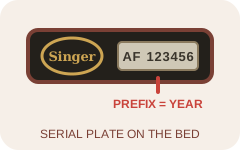 Serial prefix dates it
Photograph the serial plate on the bed (AD/AE/AF/AG/AH… prefixes map to years). A blue "Centennial 1851-1951" badge adds a premium; white/green 221K machines are 1960s.
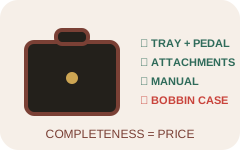 Open the case
Tray, attachments box, manual, foot controller, and the bobbin case under the bed. Missing bobbin case is the classic gotcha: expensive to replace, always check.
- Confirm the model: 11-pound black machine, flip-up bed; free-arm = 222K.
- Photograph the serial plate and any Centennial badge.
- Look under the bed: is the bobbin case there?
- Inventory the case: tray, attachments, manual, pedal.
- Turn the handwheel: smooth motion; test-sew if power is handy.
- Judge decals: bright gold beats worn silver ghosts.
No case or extras, decals decent, bobbin case present.
Case, tray, attachments, manual, pedal: sews. Sells $250-400.
Blue commemorative badge on the arm.
1960s variants, clean shells.
Removable bed, feed-dog drop, the grail. Sells $800+.
Seized, rusted, or missing bobbin case.
- Missing bobbin case but priced as complete.
- Seized motor or frozen handwheel at working-machine prices.
- Repainted machines sold as original finish.
- Cracked bed or broken flip-up extension.
- A full-size machine in a cabinet: that's not a Featherweight, and it doesn't sell.
Questions collectors ask
What separates a Singer 222K from a 221 Featherweight?
The 222K has a removable free-arm bed section. Confirm that feature with the model details and serial number instead of relying on color, decals, or a seller label.
What can a Singer serial number tell you?
It can support an approximate production period and factory when checked against a reliable allocation list. It does not describe current condition, completeness, or value.
Why must the Featherweight bobbin case be checked?
The machine cannot make a normal stitch without the correct case, and replacements affect cost and originality. Photograph it in place and removed before buying.
Link disclosure: eBay links currently open ordinary sold-search results. If a link becomes commission-earning in the future, it will be clearly identified near the link.
Marker images mix real examples (credited, via Wikimedia Commons) and hand-drawn diagrams. Prices reflect eBay sold ranges as of July 2026.