Cookware · Erie, PA & Sidney, OH · 1865-1957
Griswold & Wagner Cast Iron
Turn the pan over. The logo, place name and numbers narrow the search; the cooking surface and a flatness check decide whether it is worth buying.
Compare four real pan bottoms before assigning an age ↓
The skillet looks ordinary from above. Turn it over and there are two numbers: a large 8 and a smaller 704, followed by a letter. Neither gives you a year. Griswold in Erie, Pennsylvania, and Wagner in Sidney, Ohio, made cookware in many sizes and patterns, leaving collectors a useful paper trail cast into the iron. Copy the whole bottom before opening a price search. A close-up of the famous cross leaves too much of that trail outside the frame.

Act IRead the bottom like a coin
The italic slant logo and the upright large-block logo overlap in use, so "slant means before 1915" is too neat. The small-block mark arrived around 1939. Look beyond the lettering: "ERIE" and "ERIE, PA, U.S.A.", the heat ring, handle and pan shape help narrow the period. A casting scar on the bottom is a manufacturing clue, not a maker's signature or an exact date. When the features disagree with a reference, leave the year open and photograph the mismatch.

Act IITeflon kills the foundries
Nonstick coatings and cheap imports arrived in the 1950s, and heritage finishing couldn't compete on price. Griswold sold in 1957 after ninety-two years; the brand names shuffled between owners until both Griswold and Wagner marks ended up stamped on ordinary pans. That's why era matters more than name: a 1990s "Wagner's 1891 Original" is a $10 user, while a slant-logo Griswold is a collector piece.
Act IIIThe restoration revival
The last fifteen years flipped the market. Cooking culture rediscovered bare cast iron, and a restoration hobby grew around it: electrolysis tanks and lye baths stripping a century of crud off garage-sale pans to reveal mirror surfaces. Skillets are the volume market; the money climbs with big sizes (#10 and up), matching lids, and odd shapes: dutch ovens, waffle irons, muffin pans. Wagner runs cheaper than Griswold for comparable quality, which makes it the value play.
Early logo eras (ERIE, slant, large block), machined-smooth surfaces, big and odd pieces, matching lids, and pans that sit dead flat.
Serious home cooks, logo-era collectors, restoration hobbyists buying crusty pans to strip, and homestead-kitchen decorators.
Crud is fine. Cracks are fatal. A $5 pan under black grime can be a $75 pan after electrolysis, but no restoration fixes a crack, a wobble, or deep pitting.
Sources: Smithsonian: Griswold frying pan record · Cast Iron Collector: Griswold trademark evolution · Cast Iron Collector: pattern and catalog numbers · Cast Iron Collector: cracks, warp, and ring-test limits
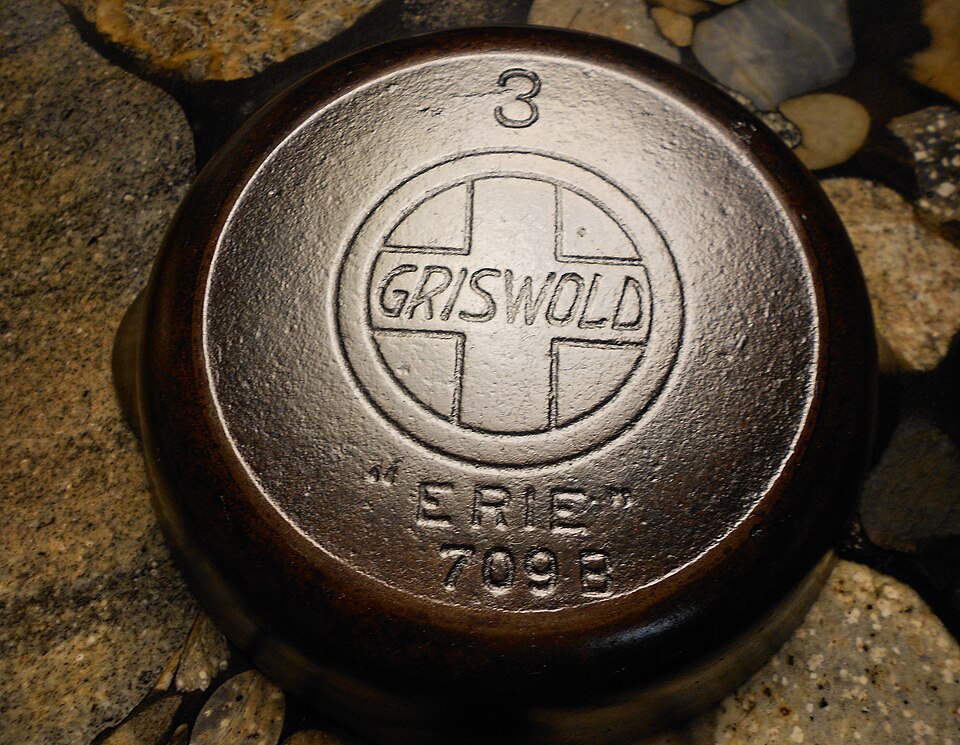 Read 3 and 709 separately
The large 3 is the size designation; 709 is a pattern number, with a letter after it. Neither is a year. Copy them with the slant logo and ERIE wording, then compare the same skillet pattern.
Photo: Modemac, CC BY-SA 4.0, via Wikimedia Commons.
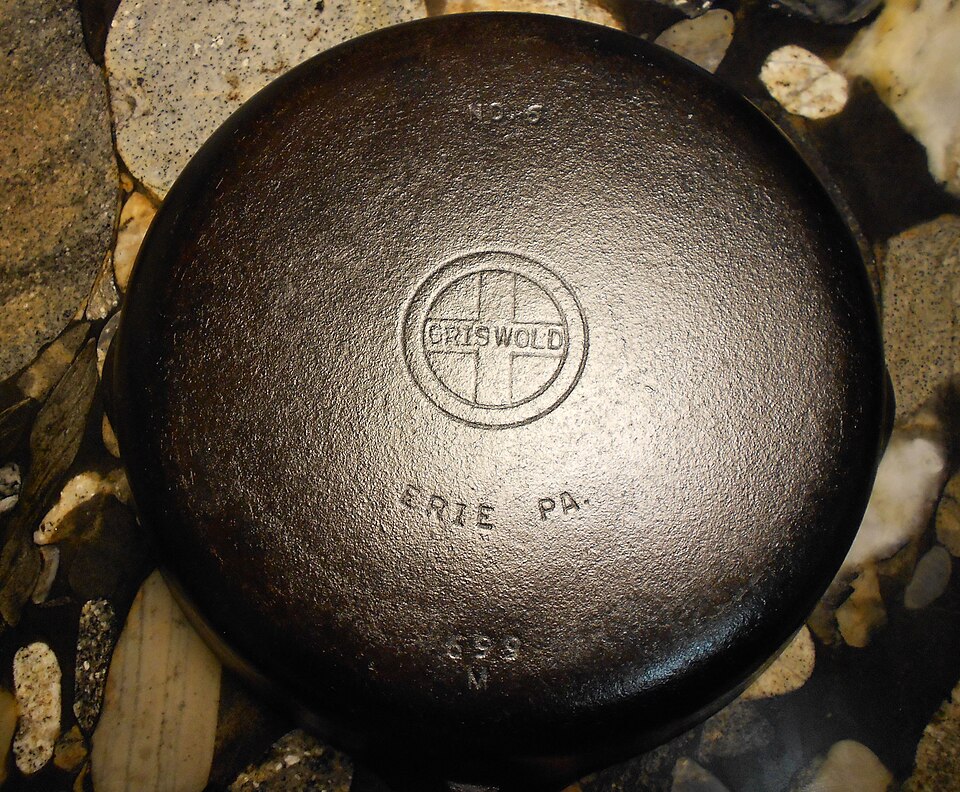 A small logo still needs a condition check
The small central logo and ERIE, PA wording differ from the slant example. This bottom view cannot show a flatness test or the cooking surface. Ask for both before using a sound-pan comparison.
Photo: Modemac, CC BY-SA 4.0, via Wikimedia Commons.
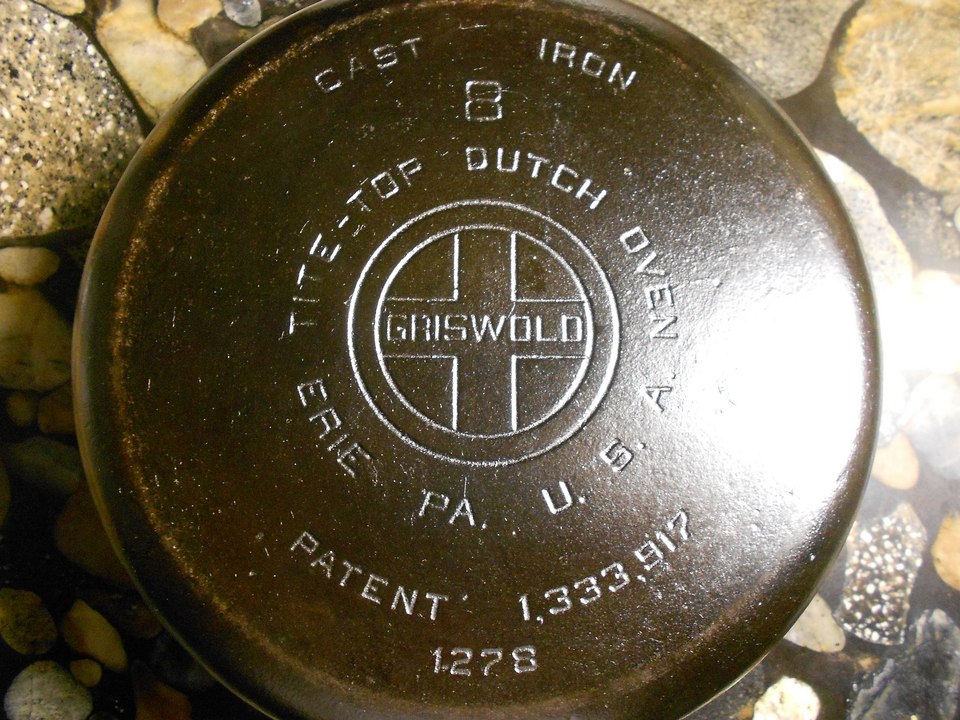 The pot mark cannot prove a matching lid
This base reads TITE-TOP DUTCH OVEN, 8 and 1278. It identifies the pot for further comparison; the lid is outside the photo. Photograph the lid marks, underside and fit before pricing a complete pair.
Photo: E.W. Modemac, CC BY-SA 3.0, via Wikimedia Commons.
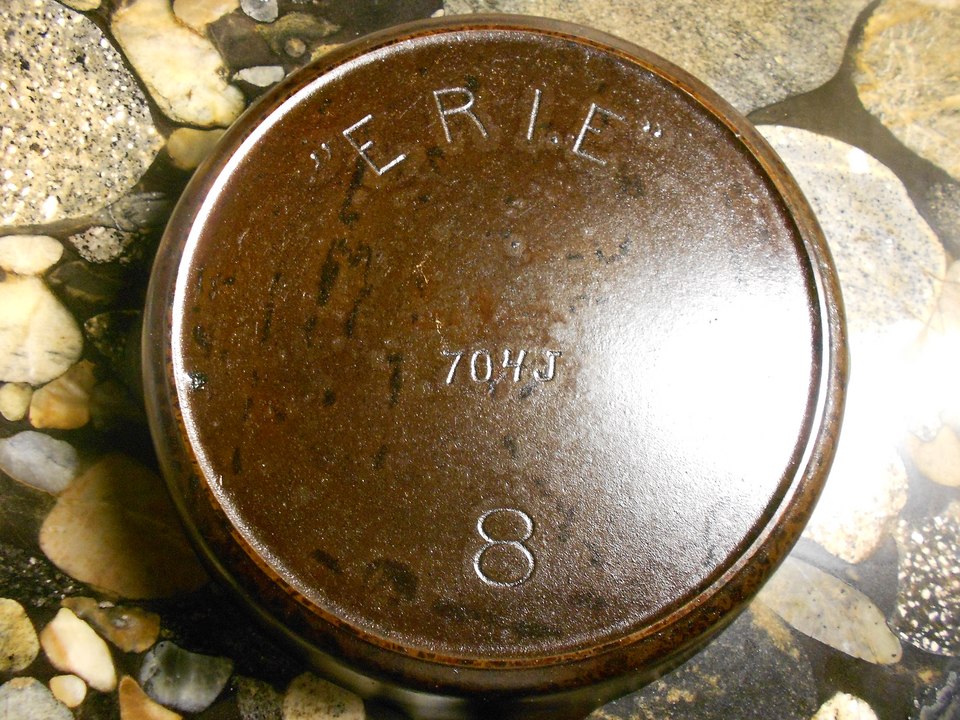 No cross does not mean no identification
This skillet reads ERIE, 704J and 8 without the familiar cross. Keep the wording intact, including the letter. Match the rim, heat ring and handle as well as the mark before assigning a period.
Photo: E.W. Modemac, CC BY-SA 3.0, via Wikimedia Commons.
- Flip it: copy the logo, place wording, size and pattern number together.
- Set it on something flat: a rocking "spinner" is warped.
- Hunt for hairline cracks at the handle and pour spouts.
- Check the cooking surface: smooth is money; deep pitting isn't.
- Heft it: vintage pans run thinner and lighter than modern.
- Crud is fine: it strips. Cracks and wobble don't.
Flat, smooth, uncracked: user pans.
Clean, sits flat, common sizes.
ERIE PA marks, smooth surface, #3-#8.
#10-#14 skillets, dutch ovens with lids, waffle irons.
Comparable quality, softer prices: the value play.
Research the mark and construction separately; a gate scar alone does not date the pan.
- Any crack, anywhere: no restoration fixes it.
- Warped bottom that rocks or spins on a flat surface.
- Deep pitting across the cooking surface.
- Welded or repaired handles.
- Modern pebbly-surface pans priced as vintage.
Link disclosure: eBay links currently open ordinary sold-search results. If a link becomes commission-earning in the future, it will be clearly identified near the link.
Questions collectors ask
Does a clear ring prove that a cast-iron pan has no cracks?
No. Tone changes with thickness and seasoning. Inspect both sides in bright light, especially the sidewall, rim, handle junction, and heat ring.
Is the number on my Griswold skillet its age or diameter?
Usually neither. A size number such as 8 is a size designation, not an eight-inch measurement. A longer pattern number identifies a casting pattern, not a year. Copy all the numbers and letters, measure the pan, and match the logo, place wording and construction before assigning an approximate period.
How should skillet warp be checked before buying?
Set the clean pan on a known-flat surface and press around the rim and handle. Look for rocking, spinning, or a bowed center, then disclose the result.
Marker photos show real examples via Wikimedia Commons (credited). Prices reflect eBay sold ranges as of July 2026.