Model railroad systems · N, HO, S, O and G · 1891 to today
Vintage Model Trains
A familiar brand earns the stop. Scale, product line, catalog number, road number, matched parts, and working condition set the ceiling.
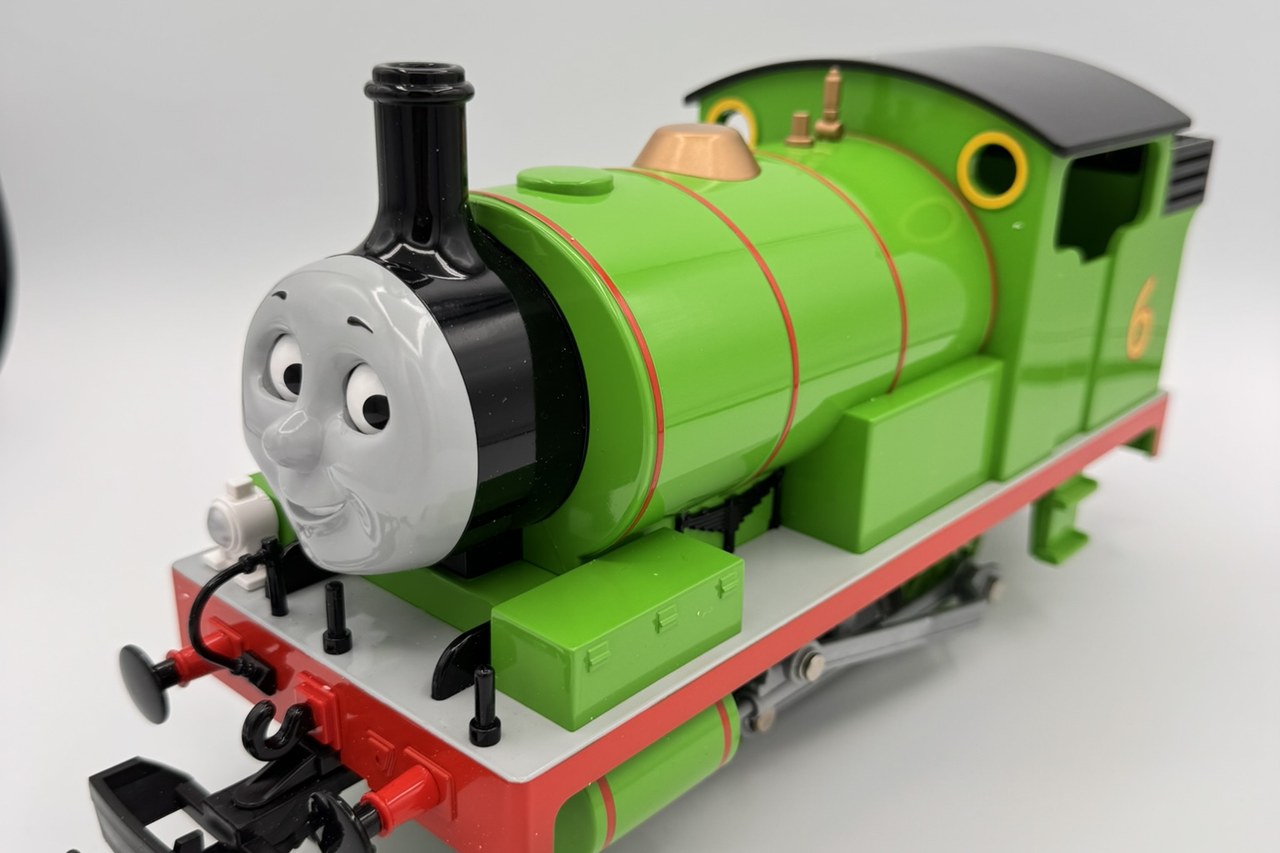
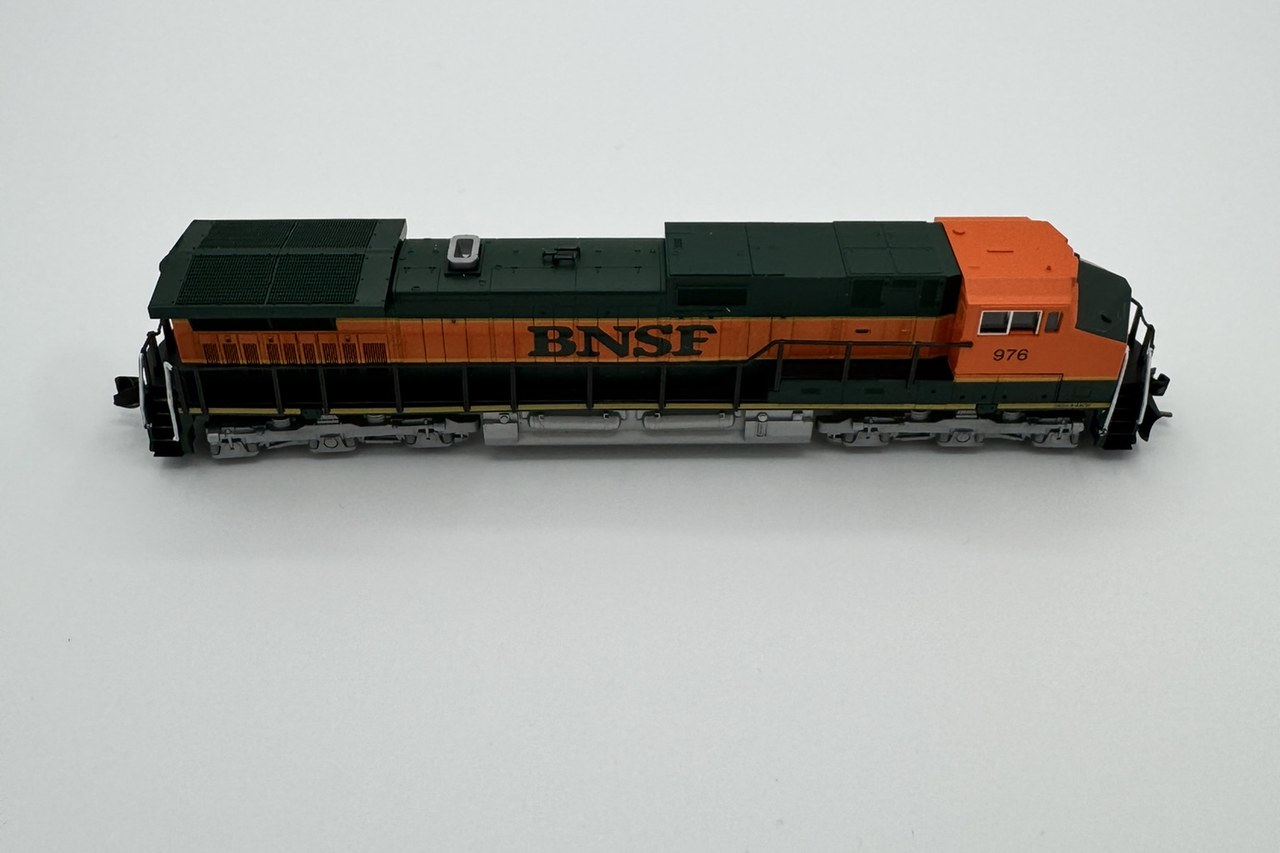
The green locomotive fills both hands. Three feet away, an orange BNSF diesel fits across a palm. Both are electric model trains. They do not share track, couplers, controls, shipping costs, or buyers. At a sale, "Who made it?" gets you only as far as the logo. The useful question is, "Which system does this exact model belong to, and what is missing from that system?"
Act IBefore the system, there was the toy
The Smithsonian dates one American tin-and-wood toy train engine to about 1850-60. It has cast-iron wheels, but no shared scale language or catalog ecosystem to guide a modern buyer. Märklin's own history places its first model railway at the Leipzig Spring Fair in 1891. The shift was larger than a new toy. Track, rolling stock, accessories, and replacements could now belong to one repeatable system.
Act IIA tiny pin made the layout work
Joshua Lionel Cowen's 1923 toy-railroad patent described an insulating pin that kept adjoining rail sections from making electrical contact. It sounds minor, but it captures the collector problem. A locomotive depends on pickups, track, transformer, control gear, couplers, and matched units. A missing tender or wrong control system can matter more than bright paint.
Act IIIScale became a common language
The National Model Railroad Association names six major size families: Z, N, HO, S, O, and G or large scale. N is commonly 1:160, HO 1:87.1, S 1:64, and O 1:48; large scale varies. That language lets track, wheels, clearances, scenery, and buyers line up. It also explains why a brand name cannot set a price. One maker may sell starter sets, detailed scale models, analog motors, sound decoders, and several sizes under the same logo.
Act IVFour and a half inches changed the hobby
In 1950, George L. Miller showed a working Pennsylvania Atlantic-type locomotive only 4 1/2 inches long at the New York Society of Model Engineers exhibition. The Smithsonian says the 1/16-inch-per-foot model helped catalyze N gauge by proving tiny working engines were possible. Miniaturization did not remove evidence. It packed more of it into road numbers, molded marks, wheelsets, couplers, and box labels.
Act VBack at the folding table
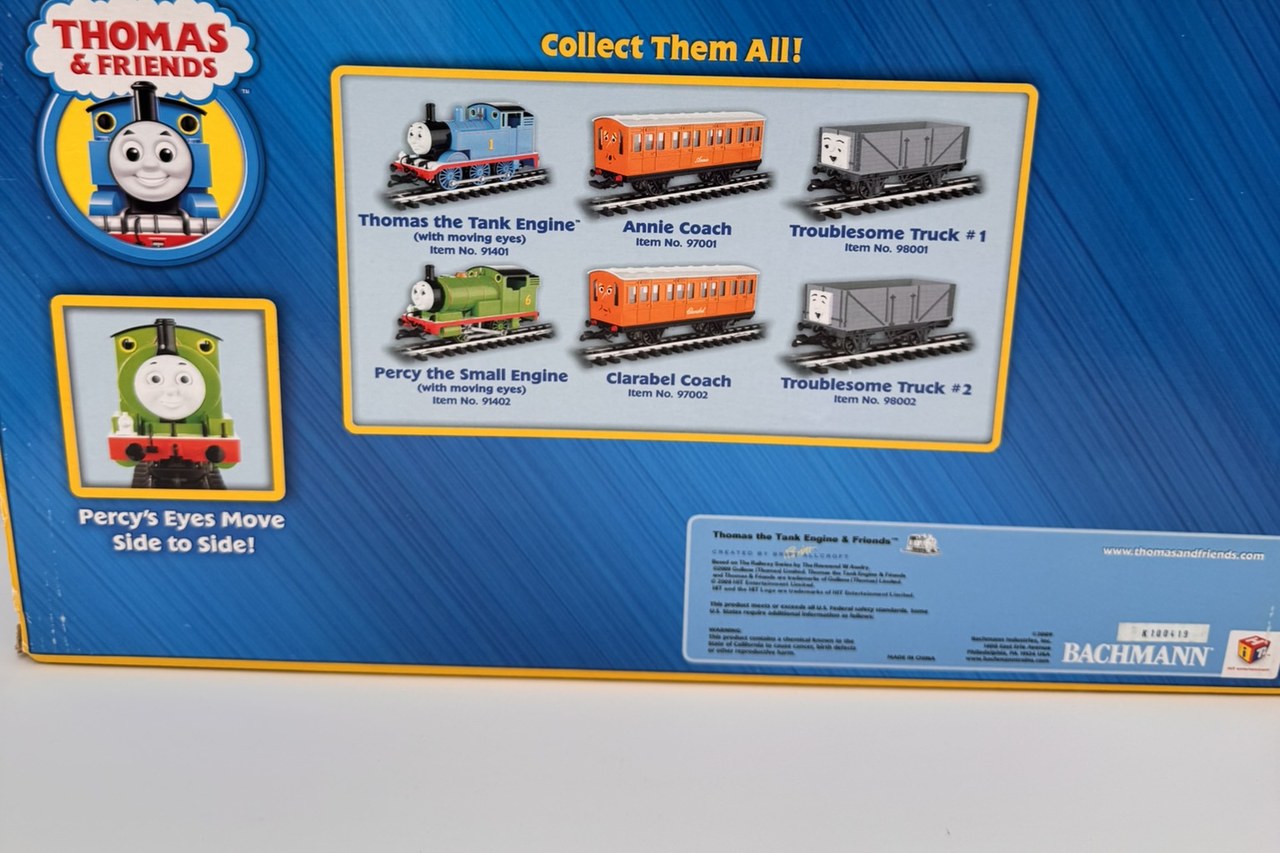
Turn the BNSF engine over. Copy 976 and Dash 9-44CW. Find KATO and the exact catalog number. Put the five Great Northern cars in one row and record all five road numbers. Read 91402 from the Bachmann box, then confirm Percy is really inside. The brand earned the pause. The system turns the pause into a price.
Exact variants complete a railroad, scarce road numbers finish a set, and compatible working models can run instead of merely display.
Layout operators, scale specialists, road-name collectors, Lionel and American Flyer collectors, live-steam hobbyists, and character-train buyers.
Buy the identity sequence, not the logo: scale, line, number, pairing, mechanics, function, then completed sales.
Sources: Smithsonian: toy train engine, about 1850-60 · Märklin: 1891 model railway history · US patent 1,671,276: Cowen toy railroad · NMRA: major scales and ratios · Smithsonian: Miller model and N-gauge development · Train Collectors Association: National Toy Train Library
 Copy every visible number
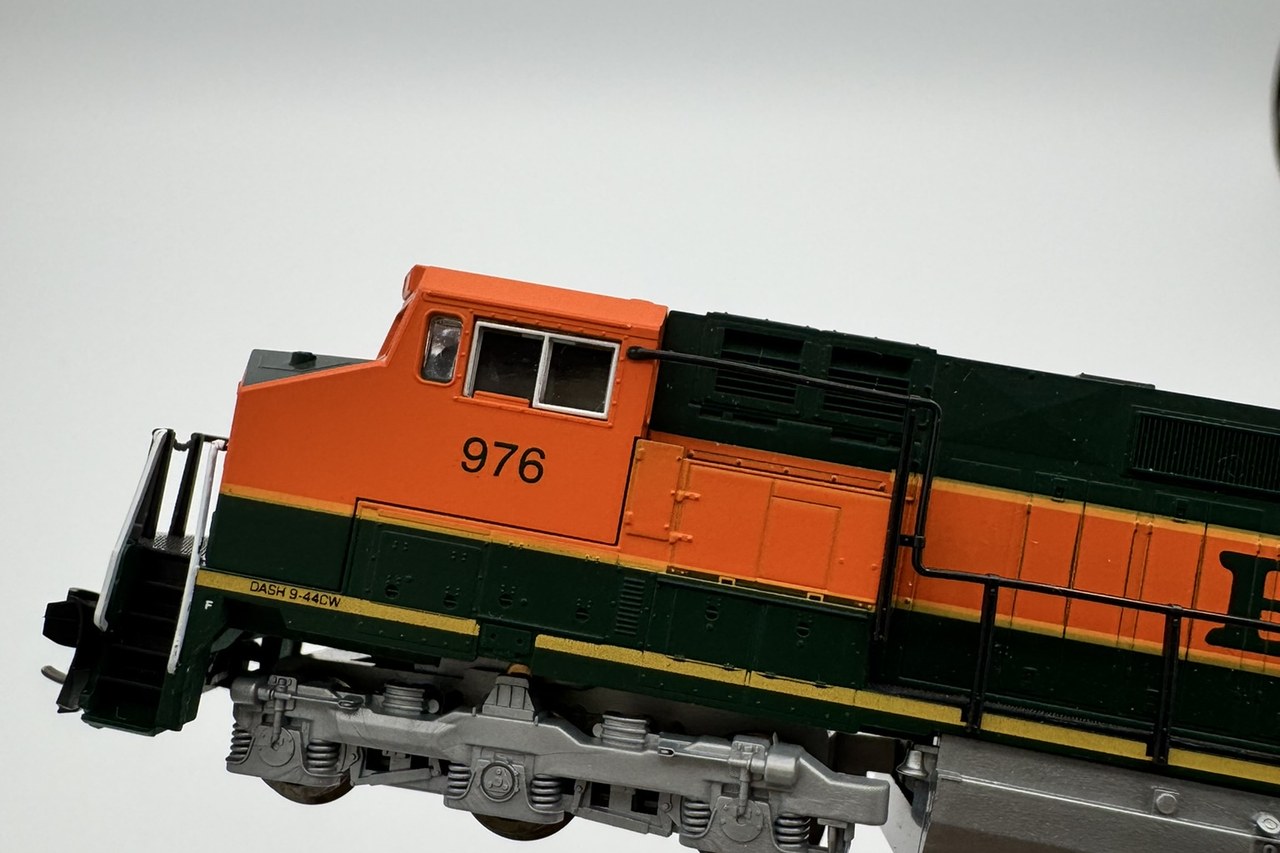
This side view gives BNSF, road number 976, and Dash 9-44CW. Those clues narrow the search, but this photograph alone cannot prove scale, maker, drive system, or function.
Photo: Judy's collection, used with permission.
 Turn the locomotive over
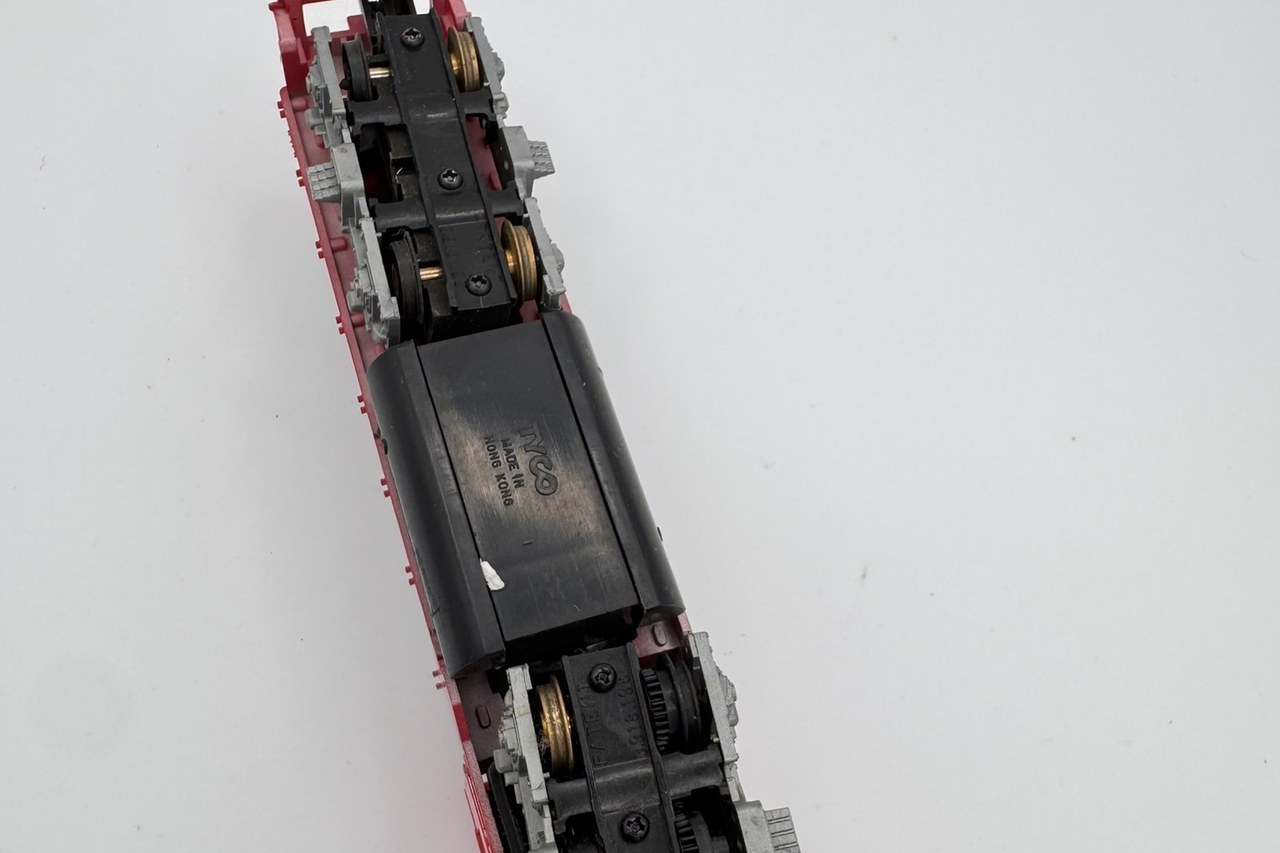
The underside reveals TYCO, Made in Hong Kong, powered trucks, gears, pickups, and wheel wear. A maker mark still does not name the exact catalog number or prove that the motor runs.
Photo: Judy's collection, used with permission.
 The box number is the shortest route
This Bachmann box prints item no. 91402 beneath Percy and lists its matching coaches and trucks. Match the label to the locomotive because boxes can migrate between models.
Photo: Judy's collection, used with permission.
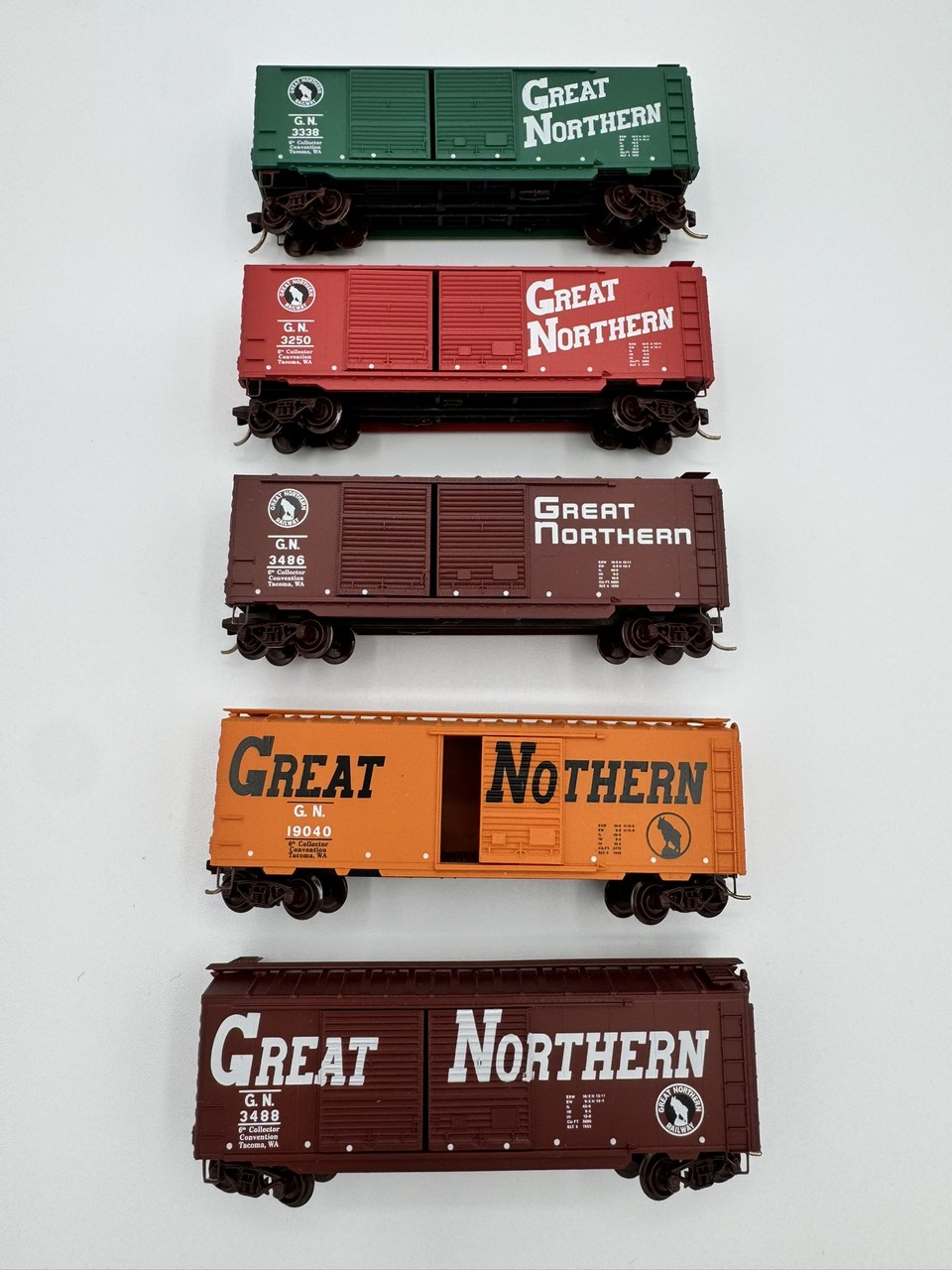 A set is a list of road numbers
These five Great Northern cars read 3338, 3250, 3486, 19040, and 3488. Photograph the group and each number so a special run can be checked as a complete set.
Photo: Judy's collection, used with permission.
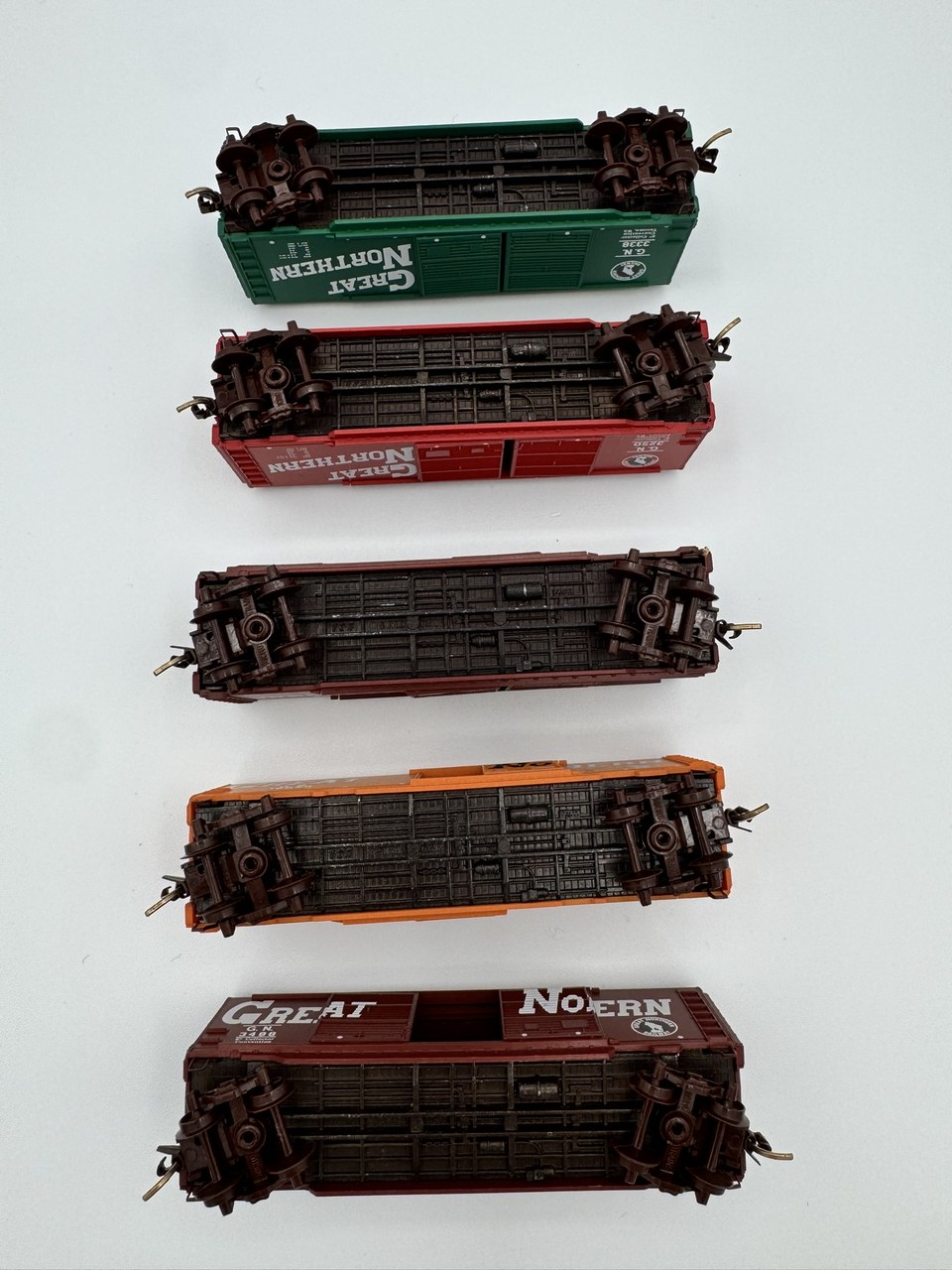 Wheels and couplers decide compatibility
Lay every car upside down without forcing details. Record maker marks, truck style, wheel material, couplers, broken stirrups, and replacements before calling a lot original or ready to run.
Photo: Judy's collection, used with permission.
- Find the scale or gauge on the box or underside. Do not guess from size alone.
- Name the product line, not just Lionel, KATO, Bachmann, Märklin, MTH, Atlas, or Athearn.
- Copy the catalog and road numbers exactly, including dashes, suffixes, and paint version.
- Inventory the partners: tender, A-B unit, transformer, remote, control module, manuals, track, and inserts.
- Inspect the mechanism for split gears, zinc swelling, corrosion, battery leakage, damaged rods, worn wheels, and altered couplers.
- Test only on a compatible system. Stop for binding, heat, smoke, burnt odor, damaged wiring, or an unknown decoder.
- Compare the exact version in completed sales and subtract shipping, testing, and return risk.
No box, no exact identity, ordinary condition.
Readable road number, sound trucks and couplers; box raises the ceiling only when it matches.
Untested or ordinary train-set line. An old box is not a working test.
Exact model and version, good cosmetics, compatible test completed.
Every correct road number present; original cases or paperwork preferred.
Catalog number, function, character or road version, and a shipping plan all confirmed.
Exact era and catalog number, correct tender or powered unit, controls, and test status.
Overland, Key, Division Point, Precision Scale, Aster, Accucraft, or costly DCC and sound.
- Zinc parts are swollen, cracked, warped, or crumbling.
- The battery compartment leaked, wiring is brittle, or the model smells burnt.
- Gears are split, side rods are missing, wheels bind, or the shell is cracked at screw posts.
- The tender, powered partner, control module, remote, or box does not match the catalog number.
- Repaint, reproduction decals, or heavy weathering are presented as factory finish.
- The seller blocks underside and number photos while asking a tested or complete price.
Link disclosure: eBay links currently open ordinary sold-search results. If a link becomes commission-earning in the future, it will be clearly identified near the link.
Questions collectors ask
Does an old Lionel, KATO, Bachmann, or Märklin name make a train valuable?
No. The name is a triage signal. Scale, product line, catalog number, road or paint version, matched tender or powered unit, electronics, condition, and exact completed sales set the value.
Which photos are needed to identify a loose model train?
Photograph both sides, both ends, the roof, the complete underside, wheels, couplers, drive rods, every printed number, and any tender, powered partner, control unit, box-end label, manual, or accessory.
How should an untested model locomotive be priced?
Price it as untested and cut the ceiling for hidden motor, gear, pickup, light, sound, or decoder faults. Use only a compatible low-power test setup, and stop for heat, smoke, burnt odor, binding, or damaged wiring.
All field and story photographs are from Judy's collection and were re-encoded without EXIF. Price evidence reviewed September 18, 2026: loose tested TYCO 5628 sold for $14.94, a boxed new-old-stock example sold for $86.24, a Micro-Trains Great Northern special six-pack sold for $61.60, Bachmann 91402 sold open-box for $179.99 plus $24 shipping, and KATO 176-3801 sold new for $105 with comparable used KATO BNSF locomotives around $65-90. These anchors are not cross-model averages.