Toys & miniature cookware · United States · after 1850
Miniature Cast Iron
A little stove can be a toy, a branded miniature or later decor. Its name and loose parts need checking before the seller's "salesman sample" story earns a premium.
A black stove sits at the end of a folding table, five inches of scrollwork with four loose pans balanced on top. The price tag says "RARE SALESMAN SAMPLE." Before the story earns a dollar, measure it. Photograph the name on the door. Lay every lid and pipe section beside it. Miniature iron divides into toys, matching toy cookware, branded miniature cookware, and later souvenir decor. Those lanes can look alike from three feet away and sell very differently.
Act IA kitchen small enough to play with
The Smithsonian holds a Victorian child's cast-iron cook stove made after 1850 with four burners, removable lids, a two-part pipe, kettles, saucepans, a skillet, and a toy iron. These were not always passive dollhouse props. The Strong documents small stoves that burned coal, alcohol, or wood so children could imitate real kitchen work. Their danger is part of their history, but age and function still do not turn every example into a factory sample.
Act IIThe catalog catches the salesman-sample story
A Hubley catalog sold an Eagle Range as a toy and printed its dimensions: 12 1/2 by 12 by 6 inches, cookware included. The same page announced, "No Toy House Is Complete Without a Stove." That one catalog page is stronger evidence than a handwritten tag at an estate sale. Genuine sales tools can exist, but the claim needs a factory catalog, model match, or provenance that connects the miniature to the full-size product.
Act IIICompleteness is part of the object
On a toy range, the stove is only the center of the set. Burner lids, grates, oven doors, side shelves, stovepipe sections, coal tools, pots, and pans may all belong to the model. One missing plate can be easy to notice and hard to replace. Random miniature cookware does not automatically complete it. Arrange the loose pieces, count them, and compare the exact model before paying for a "complete" set.
Act IVA tiny pan can open another market
Loose miniature skillets and dutch ovens deserve their own underside photo. Most are low-cost toy or souvenir pieces. A clear ERIE, Griswold, Wagner, advertising name, or specialty-maker mark can move one into a different collector search. Buy the proof first: exact wording, pattern number, size, casting quality, and a matching completed sale.
Documented makers, named models, original nickel or enamel, crisp casting, complete parts, matching cookware, and boxes or catalogs.
Antique toy collectors, stove specialists, doll and play-kitchen collectors, cast-iron collectors, and miniature cookware buyers.
Do not pay for "salesman sample." Pay for a readable model, coherent parts, sound iron, and evidence that survives the listing title.
Sources: Smithsonian: Victorian miniature stove parts · Smithsonian: Kenton toy stove · The Strong: working toy stoves · LancasterHistory: Hubley catalog archive · Hubley cast-iron toy catalog scan · The Henry Ford: iron condition guidance
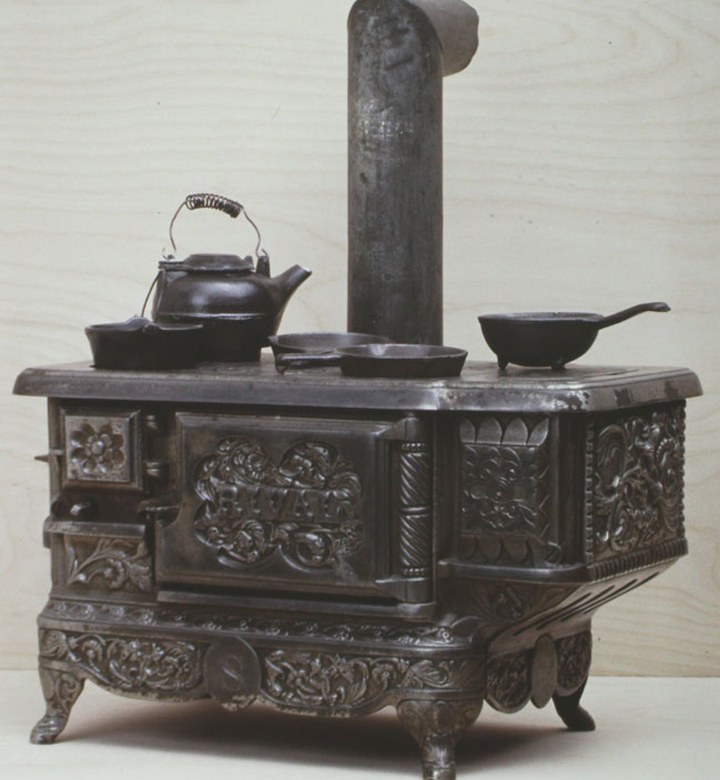
A museum example, not a match for every stoveThis Rival is cataloged as a toy stove. That does not identify another small black stove from resemblance alone. Measure yours and photograph every side before comparing the doors, feet and casting.
Photo: The Children's Museum of Indianapolis, CC BY-SA 3.0, via Wikimedia Commons.
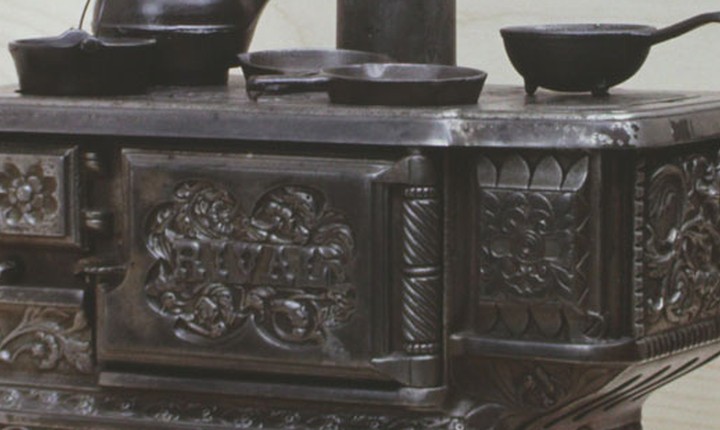 RIVAL is the word to search first
The door reads RIVAL. Record that name without assuming it is a foundry name. Photograph the underside and back for more marks, then compare the casting and dimensions with a documented model.
Cropped from the same museum photo, CC BY-SA 3.0.
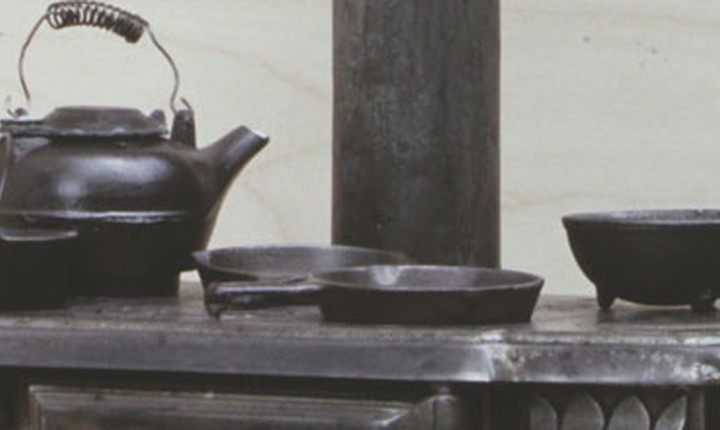 A display is not a parts inventory
The kettle and pans hide part of the stovetop in this photo. They cannot prove that all burner lids are present. Ask for the loose pieces laid beside the stove and a clear view of every opening.
Cropped from the same museum photo, CC BY-SA 3.0.
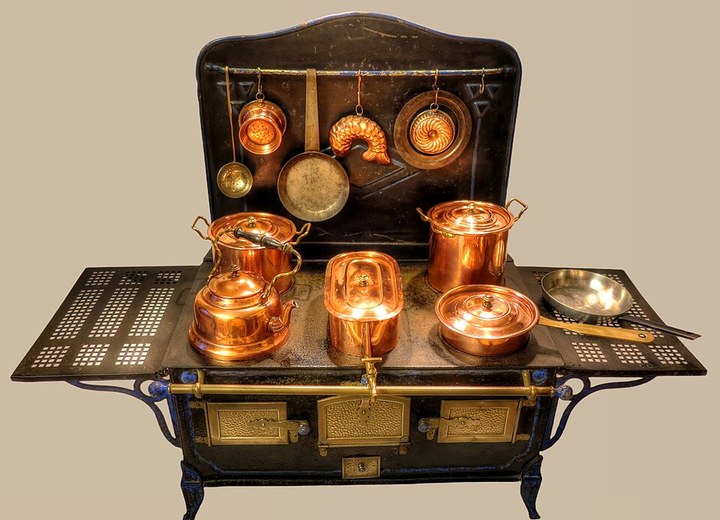
Scale does not prove cast ironThis antique stove is tin with copper cookware. Photograph seams, underside, broken edges, and mixed materials instead of guessing from black paint or weight.
Photo: Richard Huber, CC BY-SA 3.0, via Wikimedia Commons.
- Measure the whole object beside a ruler and photograph all sides.
- Choose the lane: toy stove, toy cookware, branded miniature, or souvenir decor.
- Read every mark on doors, base, underside, handles, and loose pans.
- Count the parts: lids, grates, shelves, pipe, tools, cookware, box, and instructions.
- Check structure: feet, hinges, doors, rims, and screw points for cracks or repairs.
- Search the exact model before accepting a salesman-sample or rare-maker claim.
Later decor, candle holder, or rough reproduction.
Missing lids, pipe, doors, or model identity.
Sound iron with coherent parts and a readable model.
Correct early model, strong finish, and good completeness.
Underside wording and pattern number can create a separate market.
Freight, heat damage, completeness, and provenance decide the deal.
- A foot, hinge, door, rim, or body panel is cracked or repaired.
- Fresh black paint hides casting texture, filler, or active rust.
- Key lids, grates, doors, or pipe sections are missing at a complete-set price.
- The salesman-sample premium rests only on the seller's wording.
- The lot has no ruler, underside, mark, or arranged-parts photos.
Link disclosure: eBay links currently open ordinary sold-search results. If a link becomes commission-earning in the future, it will be clearly identified near the link.
Questions collectors ask
Is every miniature cast-iron stove a salesman sample?
No. Historic catalogs and museum records identify many small stoves as toys. Require a documented factory relationship, catalog listing, or reliable provenance before using salesman sample as a value claim.
Which missing parts matter most on a cast-iron toy stove?
Compare the exact model, then count burner lids, grates, doors, shelves, feet, stovepipe sections, tools, and matching cookware. One loose pot is not proof that the set is complete.
Does the name on a toy stove identify its maker?
Not necessarily. A name on the front may be a model name. Record it exactly, then photograph the underside, back and doors for other marks. Confirm a foundry through a catalog match or documented museum record rather than turning the first readable word into a maker attribution.
What-to-look-for images are real photographs with concise credits. Buy ceilings reflect completed eBay results reviewed in August 2026.