Hand-blown glass ornaments · 1985-present
Christopher Radko
The name, item number, and glass neck matter more than the glitter, because collectors search for one exact design, not a general look.
The official Christopher Radko history begins with a family Christmas tree falling and breaking more than a thousand vintage glass ornaments. Unable to find replacements with the same character, Radko enlisted a Polish glassblower and began making new ones. In 1985, sixty designs debuted. What started as a repair to one family's Christmas became a named, numbered catalog of European glass ornaments, a system precise enough that a collector can hunt for one missing Santa decades later.

Act ISixty designs become a language
Radko's breakthrough was not simply reviving blown glass. Each sculptural figure had a name and an identity: Santas, houses, animals, food, travel, Halloween, and licensed characters could be collected by theme. The official history says more than eighteen million ornaments have been produced across forty years. That volume makes the brand familiar, while the constant stream of individual designs keeps the hunt specific. A common Santa and a scarce event piece can look equally elaborate until the box label settles the question.

Act IIWhy the surface looks alive
The brand describes a weeks-long process in Polish workshops: an idea becomes a carved mold, hot glass is blown into shape, the interior is silvered, and the exterior is painted and glittered by hand. Small variations are part of the object, but damage is different. Paint rub, missing glitter, a chipped point, or a hairline around the neck changes what a collector will pay. The cap hides the most dangerous area, so field inspection begins where the ornament meets the hanger.

Act IIIThe retirement list creates the chase
At the end of a season, some designs leave production. Radko's official retirement archive runs from the early 2000s through 2025 and explains that a retired idea may return in another color, but never in exactly the same form. The company also keeps digital catalogs for older identification. This gives the secondary market a shared vocabulary: exact name, item number, year, size, and colorway. "Retired" opens the research; it does not prove rarity or a high price.
Act IVThe collector tree is still growing
This is not a closed vintage market. The official 2026 Fine European Glass collection lists more than three hundred designs, with classic-size pieces, Little Gems, limited editions, and themes beyond Christmas. New retail prices create a substantial starting point, but resale is uneven: ordinary older pieces can sell cheaply while an exact limited, licensed, Italian, oversized, or retailer-exclusive design attracts a focused buyer. The field advantage comes from identifying that distinction before the ornament leaves its box.
Exact retired designs, early pieces, numbered editions, retailer or event exclusives, unusual Italian constructions, oversized finials, and replacements for a broken family ornament.
Dedicated Radko collectors, theme-tree decorators, replacement hunters, licensed-character fans, and fine-glass ornament buyers.
Lift the cap enough to inspect the neck, then photograph the box label. A beautiful ornament without a matching identity is a low-ceiling gamble.
Sources: Christopher Radko: History · Christopher Radko: Retirement lists · Christopher Radko: Catalog and identification FAQ · Christopher Radko: 2026 Fine European Glass collection
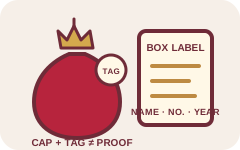 Cap and tag are clues
A crown-style cap, Radko tag, or hanging medallion supports identification but is not proof by itself. Caps move and boxes get swapped. Match the ornament to a catalog entry.
Name / item number / yearPhotograph the full box label, barcode, size, and price sticker. Search the exact name and number. Broad searches mix common modern pieces with genuine rarities.
Line / country / neckSeparate Fine European Glass, Little Gems, Shiny Brite, and other product lines. Country helps identify the line, not authenticity. Inspect the glass neck under the cap.
- Read the box label: exact name, item number, year, size.
- Match box to ornament by shape, colorway, and catalog image.
- Check cap, tag, medallion, and any edition number.
- Lift the cap gently: inspect the full glass neck for cracks or glue.
- Scan every point and edge for chips, paint rub, and glitter loss.
- Search exact name + item number, completed sales only.
No matching box, item number, reliable tag, or catalog record.
Identifiable shape, intact neck, but no exact label or packaging.
Box matches; name, number, and year are clear; exact sold value is at least about $25.
Large Santa, tiered drop, finial, Halloween, or detailed scene; inner packing present.
Early issue, complex Italian construction, numbered edition, retailer, event, charity, or licensed exclusive.
Confirm and pair each box; price cracked, mismatched, or unidentified pieces at zero.
- Box front and full label: ornament name, item number, year, size, barcode, and price sticker; then the ornament beside the box to prove the pairing.
- Cap, tag or medallion, country mark, signature, and edition number; gently lift the cap and photograph the entire glass neck.
- Front, back, underside, every point and protruding detail; use angled light to show paint rub, glitter loss, glue, chips, and hairlines.
- "Radko style" is the only attribution, but the price assumes a real Radko.
- The box and ornament do not match, or the name and number cannot be verified.
- The neck is cracked, chipped, or glued beneath the cap.
- Points are missing, internal parts are loose, or paint and glitter loss dominate the face.
- The seller treats "retired" as proof of value without an exact completed sale.
- A Radko-era Shiny Brite set is being priced as Fine European Glass.
Questions collectors ask
Does a crown-style cap prove an ornament is Christopher Radko?
No. Treat the cap and hang tag as clues. Confirm the ornament name, item number, year, line, box label, shape, decoration, and documented catalog match.
What should be copied from a Christopher Radko box?
Record the complete ornament name, item number, year, collection or line, barcode, retailer notes, and any limited-edition statement. Photograph every label panel.
Where do Christopher Radko ornaments commonly hide serious damage?
Check the glass neck beneath the cap, narrow tips, attached parts, and deep indents. Fine cracks, glue, and missing components can disappear in glitter or paint.
Link disclosure: eBay links currently open ordinary sold-search results. If a link becomes commission-earning in the future, it will be clearly identified near the link.
Process photos show licensed examples of traditional European glass ornament craft, not Radko factory production. Marker art is an approximation. Prices reflect eBay sold ranges as of July 2026.