Glass Christmas ornaments · Max Eckardt & Corning, 1937-1960s
Shiny Brite & Vintage Christmas
A Shiny Brite box narrows the era. The cap, hanger, silvering, and decoration do the dating.
American Christmas glass starts where our marbles story started: Lauscha, Germany, whose workshops blew the silvered baubles F.W. Woolworth imported by the millions from the 1880s on. Max Eckardt, a German immigrant in New York, built his business importing exactly those ornaments. By 1937 he could read the news well enough to know his supply chain was about to be torpedoed, so he went to Corning Glass Works with a proposal.

Act IThe lightbulb machine
Corning's ribbon machine existed to blow lightbulbs by the thousands per minute. Adapted for ornaments, it did in a shift what a Lauscha family did in a season. Corning blew the blanks; Eckardt's plants silvered, lacquered, and boxed them under a name that promised exactly what the old German imports couldn't always deliver: Shiny Brite, silvering that stayed bright. By the early 1940s, American machines had replaced a century of German hand labor.
Act IIThe war look
Then the war reached the ornaments themselves. Metallic lacquer became hard to get, and metal was diverted to military use. The look changed in stages. Some 1942-45 pieces went unsilvered but kept a thin metal cap. From 1943-45, folded cardboard hangers and cardboard-and-string assemblies appear. Families kept them for decades without knowing they were rationing artifacts. At a sale, a cardboard hanger narrows the date; a metal cap by itself does not.

Act IIIAluminum trees and the plastic sixties
The late 1950s added the Space Age to the attic: aluminum trees from Wisconsin's Evergleam and Alcoa, lit by rotating color wheels because stringing lights on a metal tree was a shock hazard. A Charlie Brown Christmas mocked them in 1965 and the market died. Fifty years later that same kitsch is the prize. Meanwhile plastics ate the glass ornament business, and Shiny Brite faded by the late 1960s (the brand was revived decades later by designer Christopher Radko).
Act IVWhat the attic box is worth
Vintage Christmas is the best seasonal flip there is: bought by the box at summer sales, sold piece by piece in November. Value stacks up from brand boxes, wartime cardboard hangers, unusual shapes and stencils, intact silvering, and aluminum trees complete with their branch sleeves and color wheels. It's the one category where the original cardboard is nearly as important as the glass.
Wartime unsilvered globes with documented cardboard hangers, boxed sets with period graphics, figural and stenciled pieces, and complete aluminum trees with color wheels.
Mid-century Christmas decorators, wartime-history collectors, kitsch lovers, prop stylists, and families rebuilding the tree they remember.
Buy Christmas in July when boxes are $2, sell in November when they're $40. Check caps first, silvering second, box art third. Never pass a color wheel.
Sources: The Henry Ford: Shiny Brite wartime construction · The Henry Ford: Shiny Brite collection record · Corning Museum of Glass: Shiny Brite ornaments
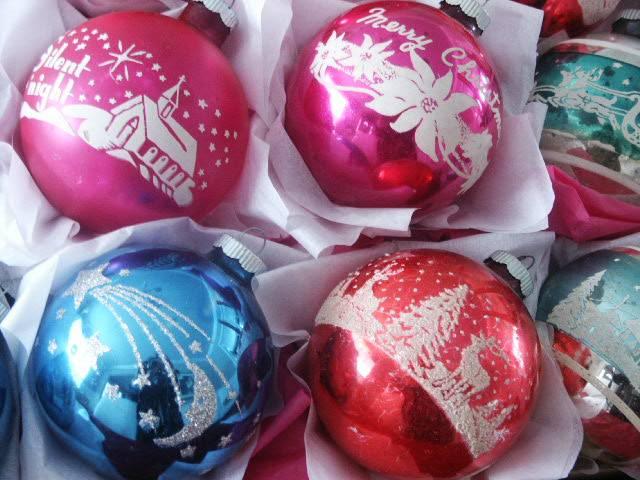 Photograph paint and silvering in daylight
Record scratches, spotting, neck chips, and faded graphics on every ornament. Then add a separate macro of each cap and the complete box label.
Photo: public domain, via Wikimedia Commons.
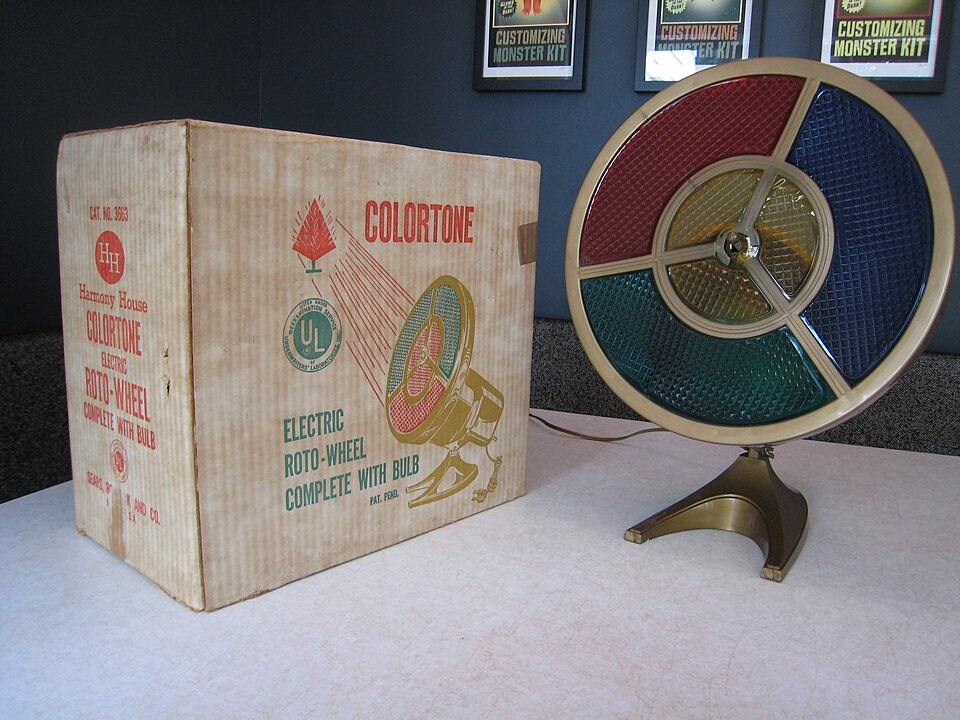 A colour wheel is a separate component
Test rotation, cord, switch, and coloured panels. Photograph the maker and box model rather than treating it as generic holiday decor.
Photo: Ataripenna, CC BY 2.0, via Wikimedia Commons.
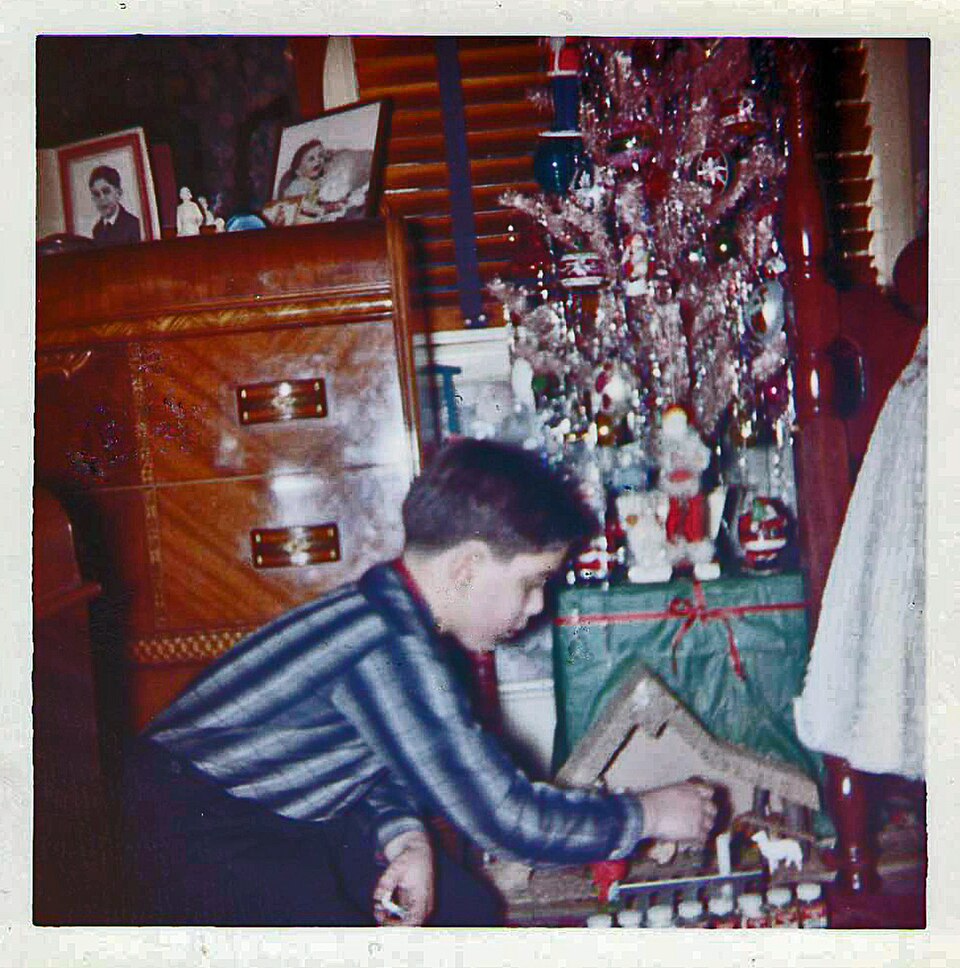 Count the tree before pricing it
Record branch count, paper sleeves, pole sections, stand, and box model. A period room photo shows the effect, not whether your set is complete.
Photo: Jim, the Photographer, CC BY 2.0, via Wikimedia Commons.
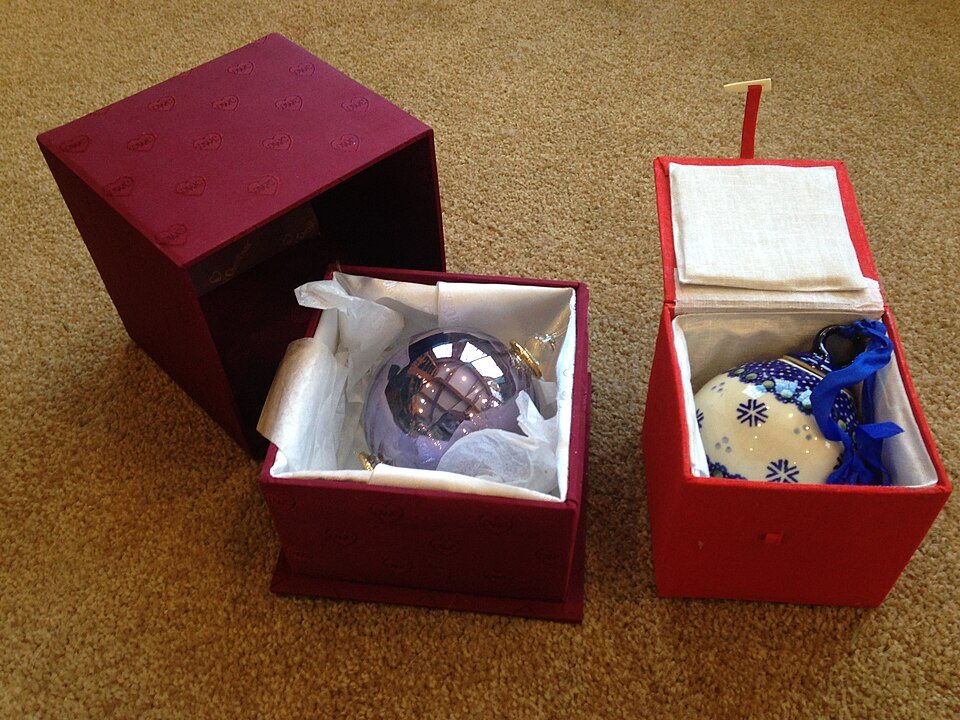 A storage box is not factory proof
Photograph any printed factory carton separately from later storage. If cap styles, shapes, or wear patterns clash, price the group as a mixed assortment until every piece agrees.
Photo: Rlsheehan, CC BY-SA 4.0, via Wikimedia Commons. Resized.
Start with the box, but do not stop there. Ornaments, caps, hangers, and even whole assortments migrate between boxes. The glass and hardware should agree with the packaging.
- Late 1930s-1941: early American machine-blown ornaments were usually silvered and finished with tight metal caps. Record the box, cap wording, glass shape, and decoration together.
- 1942-45: wartime shortages changed the hardware. Some 1942-45 ornaments were unsilvered but kept a thin metal cap; 1943-45 examples may use folded cardboard, string, and glue.
- 1946-55: silver lacquer and metal caps returned. A documented 1950-55 example carries
SHINY BRITE / MADE IN U.S.A.on its cap. - Late 1950s to about 1960: use a broad date when no catalog match survives. Some surviving groups can only be dated to about 1938-60, so box graphics or a familiar logo cannot supply an exact year alone.
Field rule: photograph the lid, bottom, every end panel, quantity and size text, dividers, each cap, and one ornament in daylight. If the materials disagree, describe it as a mixed or reboxed assortment.
- Box first: photograph all panels, size, quantity, graphics, and dividers.
- Caps and hangers: cardboard can support a 1943-45 date. Metal can be prewar or postwar, so pair it with silvering and decoration.
- Hold one to the light: is the silvering intact inside?
- Scan for shapes and stencils: figurals, indents, scenes beat plain balls.
- Aluminum trees: count branches, find the sleeves and color wheel.
Period box art, metal caps marked, silvering decent. Sells $25-60.
Look for translucent colour and a documented cardboard hanger, then make sure the box and assortment agree.
Shapes, indents, scenes. German and Japanese too.
Evergleam / Alcoa, complete with sleeves and box; wheel adds a lot. Sell $100-300.
No brand, no age, no buyer.
- Heavy silvering loss and flaking paint across the whole lot.
- Modern balls staged in old boxes at vintage prices.
- Faded, cracked, or cordless blow molds at collector prices.
- Aluminum trees missing branches or sleeves but priced complete.
- Musty, water-damaged boxes, the box was half the point.
Link disclosure: eBay links currently open ordinary sold-search results. If a link becomes commission-earning in the future, it will be clearly identified near the link.
Questions collectors ask
Does a cardboard cap prove a Shiny Brite ornament is from World War II?
A cardboard hanger is strongest for the 1943-45 wartime window, but it is not complete authentication. Check the box, ornament shape, decoration, glass, hanger materials, and provenance together.
Can a Shiny Brite box date the ornaments inside?
It can narrow the period, but it cannot prove an exact year by itself. Caps, hangers, ornaments, and whole assortments are easy to move between boxes, so the construction clues must agree with the packaging.
What changed on Shiny Brite ornaments after World War II?
Silver lacquer and metal caps returned after 1945. A 1946-55 construction can support a postwar date, but condition, cap fit, box size, and the full assortment still need to agree.
Historical dating updated August 2026. Marker images mix real examples (credited, via Wikimedia Commons) and hand-drawn diagrams. Prices reflect eBay sold ranges as of July 2026.