Canvases, kits, threads · and the finished work
Vintage Needlework
Three different objects come out of the same estate box. Only one of them is ruined by a missing piece, and the cheapest looking one is often the expensive one.
In Berlin around 1860 a firm called Hertz and Wegener printed an embroidery design in black and white on squared paper, and then somebody sat down and coloured it in by hand. A bird of paradise on a branch, in red and black and blue and green and yellow and purple, one square at a time, across a sheet twenty centimetres on a side. That sheet was the product. The wool was the easy part.

Act IWhen the paper was the expensive part
Those sheets built an industry. The wool came from Merino sheep in Saxony, was processed in Gotha, and was dyed in Berlin. Aniline dyes arriving in the 1830s widened the palette, and by mid century the patterns were shipping across northern Europe and North America, sold as single sheets so a buyer did not have to purchase a whole book to get one rose. Berlin wool production ended in the 1930s. The wool went into cushions and got sat on for eighty years. The paper is what the museums kept.
Act IIThen the hand moved somewhere else
Now the chart is a download. Walk into a needlepoint shop in Kansas City and the hand-painted canvases by one designer run from $60 to $645, most of them between $95 and $445, and nearly every one is marked out of stock because they are painted to order over months. That is a blank canvas with colour on it. No wool, no needle, no instructions. Meanwhile a complete Lanarte kit, with the evenweave, the chart, the needle and the DMC thread already sorted onto an organiser, retails between about 35 and 108 euros. The bag with everything in it costs less than the bag with one thing in it.

Act IIIFour owners, one spinner
Harry and Karnick Paternayan came to America from Turkey in 1916 and went into repairing Persian carpets. To match what they were mending they started making wool, and that wool became the American needlepoint standard. It was spun on flyer machines in Yorkshire, then by a hand-picked spinner in New England. The company passed to JCA, then to Saco River Dyehouse around 2011, which shut its doors for good in 2018. In 2020 the Collingham family bought the name, and the yarn is made again today using that same American spinner. Stitchers were never loyal to the label. They were loyal to the spinner.

Act IVOnly one of the three can be ruined
A kit is the single form here where one missing item takes the value to zero. Miss one colour out of forty and a designer kit is not a kit, it is a bag of thread. Finished work has no completeness problem at all: that sampler signs itself with a name and an age, which is the entire product. Loose thread has no completeness problem either, and often sells for more once it is broken up and listed by colour number. Three objects, three completely different sums, all of them sitting in the same cardboard box at the same estate sale.
Act VThe question that works on all three
Start with the one that costs nothing to ask: can a buyer click and get this brand new tomorrow? Ehrman still sells new kits at $140 to $220 and one Victoria and Albert panel at $1,210, so age alone is not an argument. Then hold the fabric up to a light for foxing, count the skeins against the card, and squeeze the little bag for glass beads and hand-dyed silk. The chart in there can be photocopied by anybody. The beads cannot, the painted canvas cannot, and neither can the twelve-year-old who put her name at the bottom of her own work. Look for the hand.
They are buying hours that a hand already spent: painted canvas, hand-dyed silk, lampworked beads, a chart somebody coloured square by square. Anything a machine can reproduce trends toward zero.
Mostly people who intend to stitch it and need thread that is not brittle. Then stitchers matching a discontinued colour, hand-painted canvas collectors, vintage decor buyers who want 1970s crewel packaging, and antique sampler buyers.
Age is not the filter. Availability is. Experienced stitchers know forty year old cotton goes brittle, so they discount old kits rather than paying a premium for them.
Sources: Victoria and Albert Museum: Hertz and Wegener hand-coloured Berlin design, E.3727-1915 · Textile Research Centre Leiden: Berlin wool work · Colonial Needle: the Paternayan Persian yarn history · Ehrman Tapestry: current kit retail prices · KC Needlepoint: hand-painted canvas retail prices · Cooper Hewitt: early nineteenth century American sampler
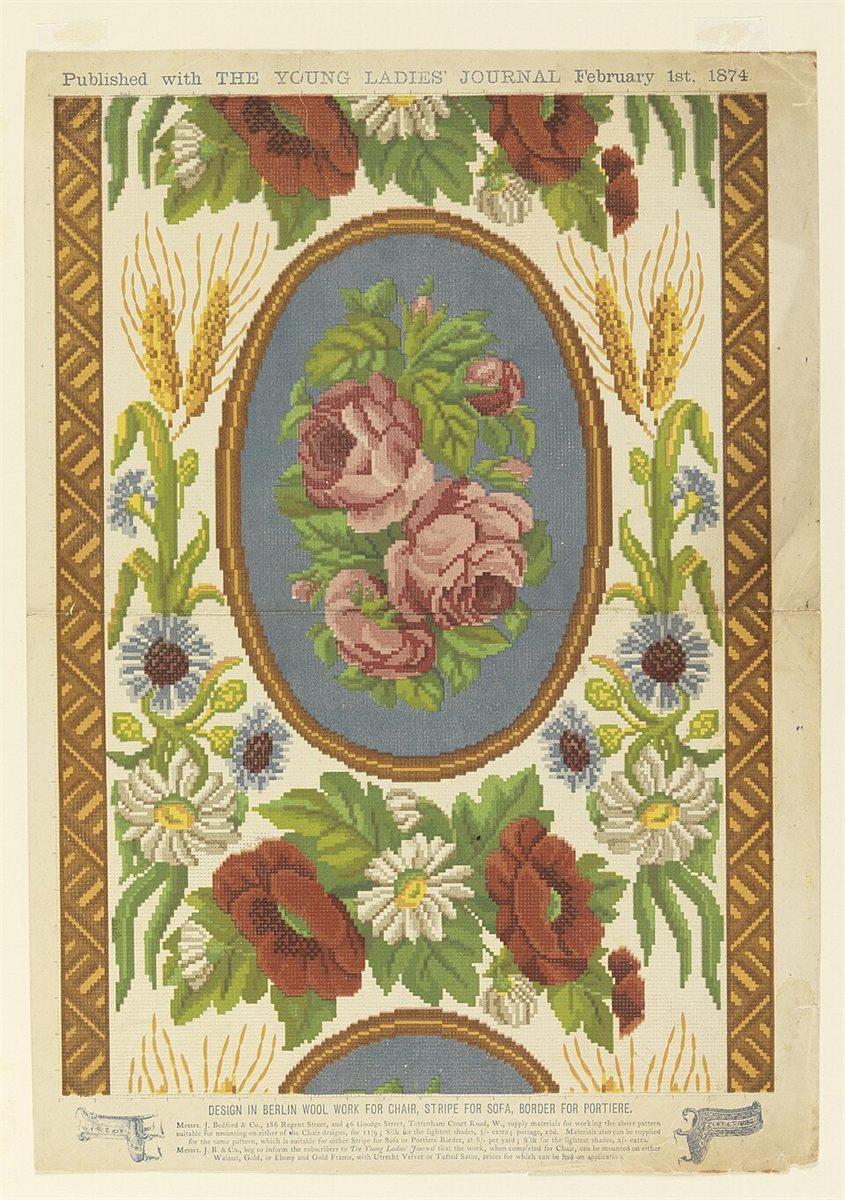 Look for work added by hand
This 1874 design combines print and hand-applied colour. On a canvas, use raking light to find brushwork riding over the mesh instead of ink stopping at each thread.
Image: Cooper Hewitt, public domain, via Wikimedia Commons.
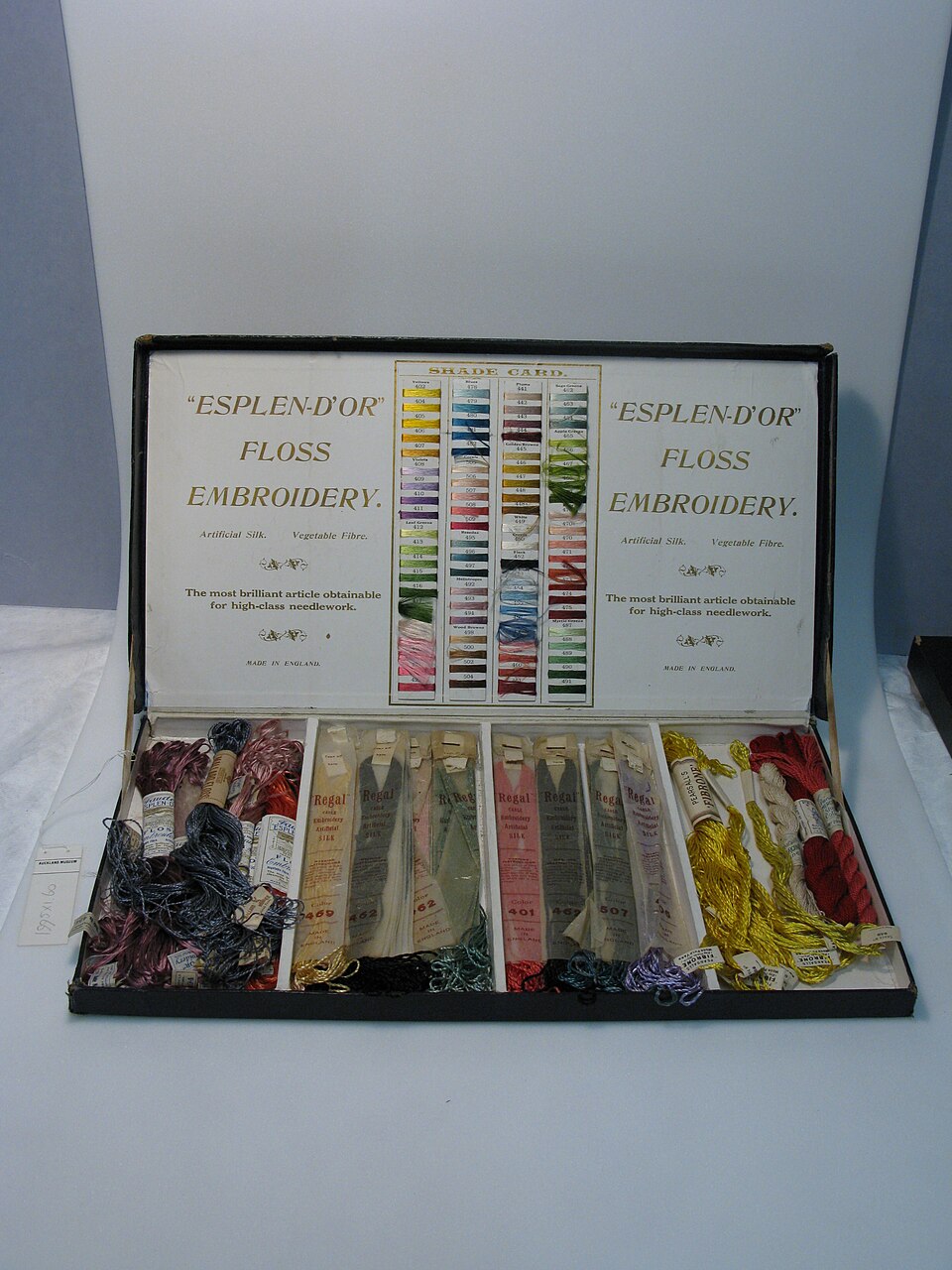 Count against the colour card
Keep the printed shade list beside the skeins and photograph both. One missing colour can turn a complete kit into a partial kit.
Photo: Esplen D'or / Auckland Museum, CC BY 4.0, via Wikimedia Commons.
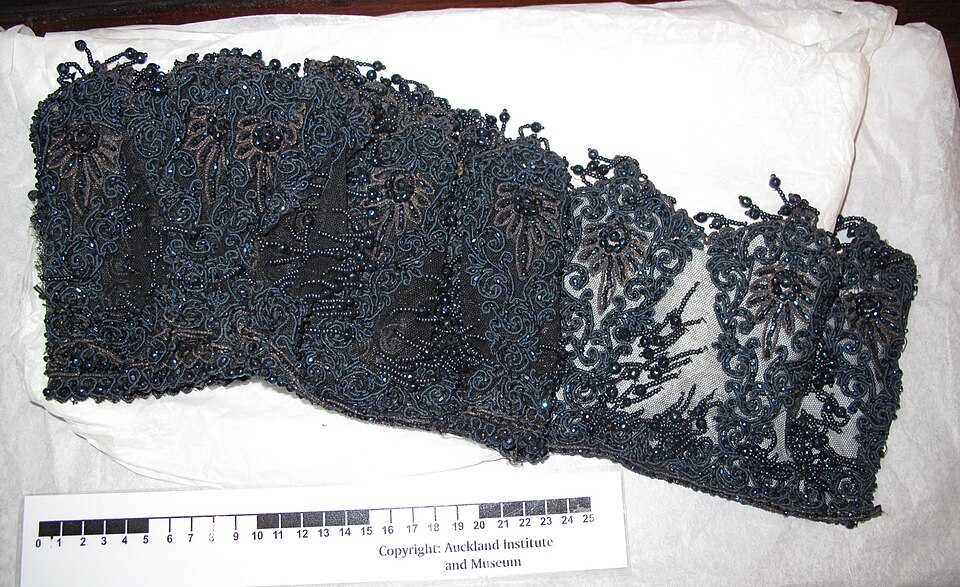 Separate beads and trims
Glass beads, trims, charms, and hand-dyed silk are saleable materials, not packing filler. Lay each type flat with a scale before valuing the lot.
Photo: Auckland Museum, CC BY 4.0, via Wikimedia Commons.
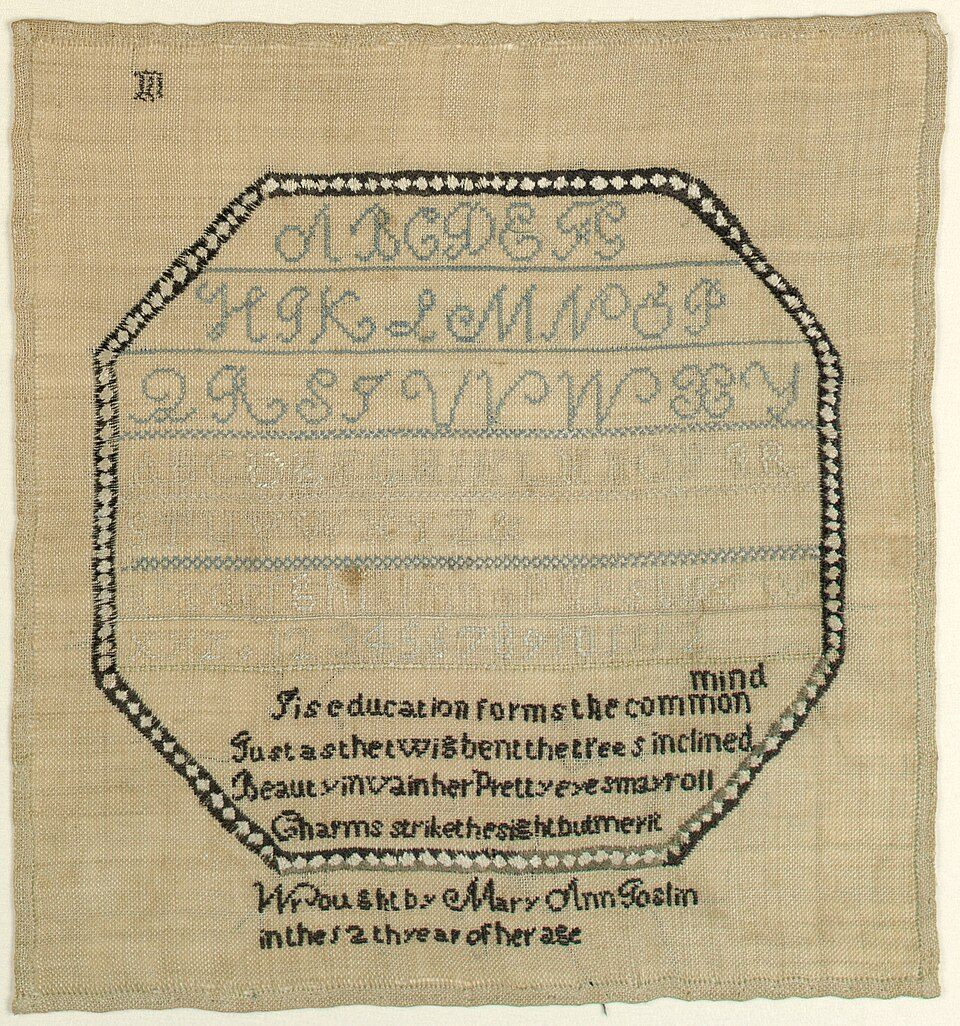 Read the stitched identity
A finished sampler sells on the stitched name, age, place, date, and subject. Photograph the entire field before checking stains, holes, and later framing.
Image: Cooper Hewitt, public domain, via Wikimedia Commons.
- Ask availability first: can a buyer order this new today? If yes, the ceiling is already set for you.
- Read the surface: hand-painted canvas or printed. This single call moves the price by an order of magnitude.
- Squeeze the bag: beads, treasures and hand-dyed thread mean a designer kit worth researching.
- Light the fabric: foxing, tidelines, insect holes, and the smell of the box.
- Count only if it is a kit: finished work and loose thread do not need to be complete.
- Name it precisely: designer, design name and article number, then search that, never the designer alone.
Visible brush strokes, colour pushed into the mesh, uneven edges, a designer or studio mark on the selvage.
Wool still bundled, chart present, canvas unworked.
Sealed bag of glass beads, ceramic treasures, or hand-dyed silk still inside.
Colour number labels still attached, fibre not brittle or faded. Usually worth more listed by colour than as one lot.
Mushrooms, owls, mod florals, earth tones. Sealed period packaging is most of the appeal.
A signature, a date, a readable subject, no foxing, sound glass and backing board.
Produced in the millions and mostly still available new. There is no scarcity here.
If the colour count cannot be confirmed, it cannot be priced as complete.
- The same kit can still be bought new without effort. That is the first filter, before condition or age.
- A designer kit is short of thread and there is no way to establish which colours are missing.
- The fabric shows foxing, water tidelines, or insect holes, or the box smells of smoke.
- All you have is a printed chart with no materials, since the chart is the copyable part.
- An ordinary mass-market kit carries a collector price tag.
- The subject is a birth record, an angel, or a house blessing, which almost never clear.
- Framed work has cracked glass, a damp backing board, or mildew behind the mat.
- The asking price comes from an active listing rather than a completed sale. High asks in this category tend to anchor off each other with no sales underneath.
- The cover or label with brand, designer, design name, article number, finished size, and fabric count in one readable shot.
- The instruction sheet's colour list, photographed on its own, because it is the only proof of what should be in the bag.
- Every thread laid out beside the colour card, opened kits especially, so a buyer can count for themselves.
- The canvas or fabric surface under raking light, then a second frame held up to a light for foxing, tidelines and holes.
- Each embellishment bag separately, showing whether the seal has been broken.
- Any started stitching, front and back, with an honest note about how far it got.
- For framed work: the signature, the date, the glass, and the backing board.
Link disclosure: eBay links currently open ordinary sold-search results. If a link becomes commission-earning in the future, it will be clearly identified near the link.
Questions collectors ask
Is a needlepoint canvas with no thread still worth buying?
Often it is the best item in the box. A hand-painted canvas carries hours of hand labour and can retail for several hundred dollars on its own, while a complete printed kit retails for far less.
How can you tell a hand-painted needlepoint canvas from a printed one?
Use raking light. Painted colour rides across the mesh with visible brush strokes and ragged edges, while machine printing stops cleanly at each thread and repeats evenly.
Does one missing thread colour ruin a cross stitch kit?
For a designer kit, effectively yes. Count every skein against the colour list on the instruction sheet, and if the count cannot be confirmed, price and list it as raw materials rather than a complete kit.
Price evidence checked July 28, 2026 against published retail prices rather than completed marketplace sales. Melissa Shirley hand-painted canvases at KC Needlepoint ran $60-645, most between $95 and $445, with nearly every design out of stock. Ehrman listed current kits at $140-220 with one Victoria and Albert panel at $1,210. Lanarte printed kits at Casa Cenina ran 35.24 to 108.56 euros. Retail sets the ceiling for a used copy; it is not a sold price. eBay completed listings could not be captured during this check, so the buy ceilings above are risk controls derived from retail using the 25 percent and 15 percent rules, not figures derived from comparable sales. Confirm exact-design completed sales before paying up. Availability also moves: one Lanarte design cited in earlier notes as still sold new now shows as discontinued at that retailer, so check each design rather than the brand.