Toy glass · 1840s Germany → 1992 West Virginia
Vintage Marbles
One drawer can hold modern cat's eyes worth pennies and a German sulphide worth hundreds, the pontil, the pattern, and the condition tell you which is which.
For roughly eighty years, from the 1840s to the First World War, the world's marbles came from German glasshouses, above all around Lauscha, in the forests of Thuringia. The tool that started it all was the marble scissors, a hand shear patented there in the 1840s that let a glassworker snip a hot gob off the end of a glass rod and roll it round. The snip left a rough scar, the pontil, at one or both poles. That little scar is now the first thing a collector looks for: proof of a handmade marble.

Act IWhat the Germans made
The showpieces of the handmade era were sulphides (a small clay-white figure, a dog or an eagle or occasionally a president, floating inside clear glass), along with Lutz swirls banded with coppery goldstone glitter, onionskins, and latticinio swirls with threads twisted through the core. They were expensive toys even then, and they're the top of the market now, provided the figure is intact, the glass uncracked, and the surface unbruised.
Act IIAkron, 1903: the machine era
M.F. Christensen & Son of Akron, Ohio patented a machine that rolled perfect spheres with no hands and no pontil, and when the First World War cut off German imports, American factories took the game over: Akro Agate in Clarksburg, Peltier in Ottawa, Illinois, Christensen Agate in Cambridge, Ohio, then Marble King and Vitro Agate. Much of the industry settled in West Virginia, where cheap natural gas and good glass sand made a marble cost almost nothing to fire.

Act IIIPlayground currency
Between the wars, marbles were how American kids did economics. You played "for keeps," and a pocketful of aggies was a pocketful of standing. Each factory's patterns became playground brands: Peltier's Superman and Christmas Tree, Christensen's guineas and flames, Akro's oxblood corkscrews, Vitro's brushed patches with two seams. A national tournament has crowned champions since 1922. Those same factory patterns, the rare runs of them in mint condition, are precisely what collectors pay for today.
Act IVThe cat's eye that ended an era
In the 1950s, cheap Japanese cat's eyes, clear glass with a colored vane inside, flooded the American market. Kids loved them; the factories couldn't match the price. One by one the American makers folded, until Vitro Agate, the last of the old line, stopped in 1992 and its machines went to JABO. That's why the cat's eye is the penny of the marble world: charming, everywhere, nearly worthless. It's also why anything in the jar that isn't one deserves a second look.

Act VWhat a collector sees in your junk drawer
A practiced eye reads a jar in seconds: pontil first (handmade?), then pattern (whose factory?), then size (shooters over 1" earn a premium), then condition under raking light (chips, moons, haze), then packaging, because an Akro box or a Marble King header bag can outsell the marbles inside it. Run the same sequence, in the same order, and you'll stop paying jar prices for drawer treasure.
Handmade German rarity (swirls, Lutz, sulphides, onionskins), scarce named machine-mades, big shooters, mint surfaces, original boxes and mesh bags.
Handmade-era collectors, factory specialists (Akro / Peltier / Christensen / Vitro), type collectors, sulphide hunters, and nostalgia or decor buyers.
Never price "a bag of marbles." Pontil, maker pattern, size, condition, and packaging decide whether one glass ball is $0.10 or $100+.
Sources: The Strong National Museum of Play: Marbles · Smithsonian: Marble Collections · MarbleCollecting.com: Marble ID Guide · Vitro Agate Co. guide
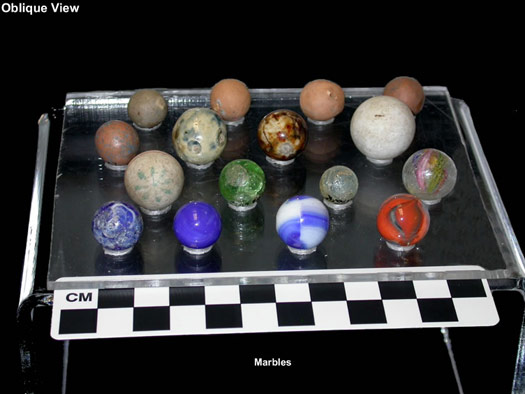 Photograph both poles and the scale
A handmade attribution needs the seam or pontil, internal construction, and diameter. One attractive overhead view is not enough.
Image: public domain, via Wikimedia Commons.
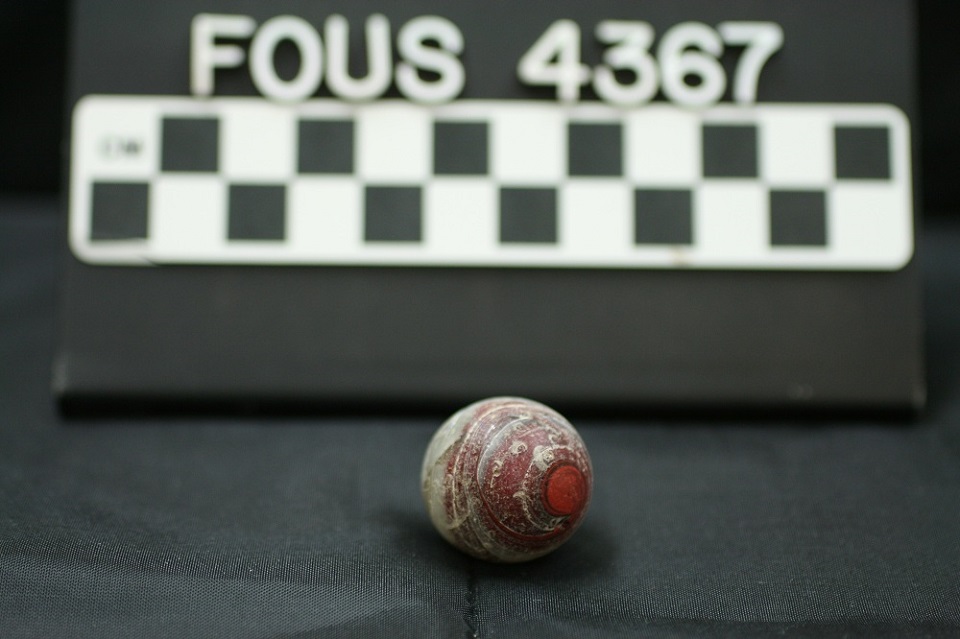 Machine-made needs a named pattern
This 1920s archaeological example is machine-made. Record seam, colours, construction, and size before assigning a maker or collector name.
Photo: U.S. National Park Service, public domain, via Wikimedia Commons.
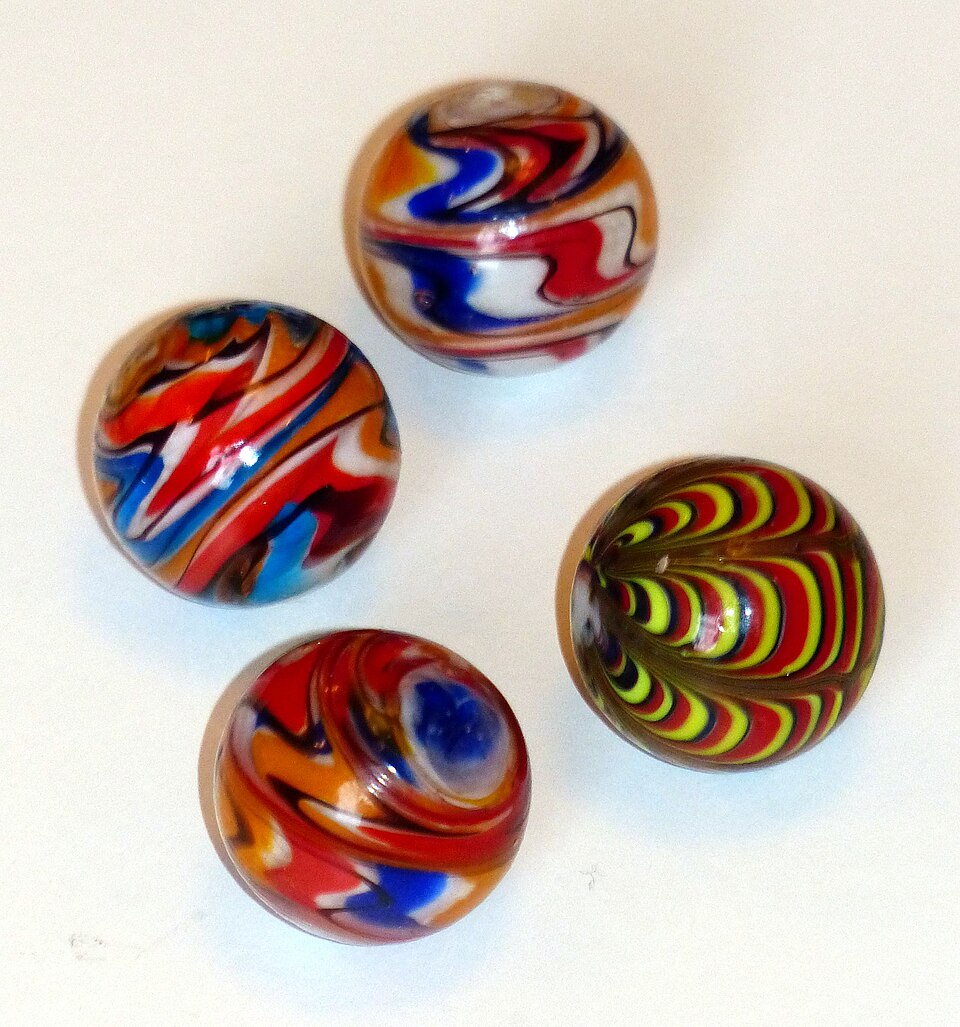 Colour alone cannot name the maker
Use daylight to record the full ribbon, patch, or flame on every side. Search a named construction only after the seams agree.
Photo: badobadop.co.uk, CC BY-SA 3.0, via Wikimedia Commons.
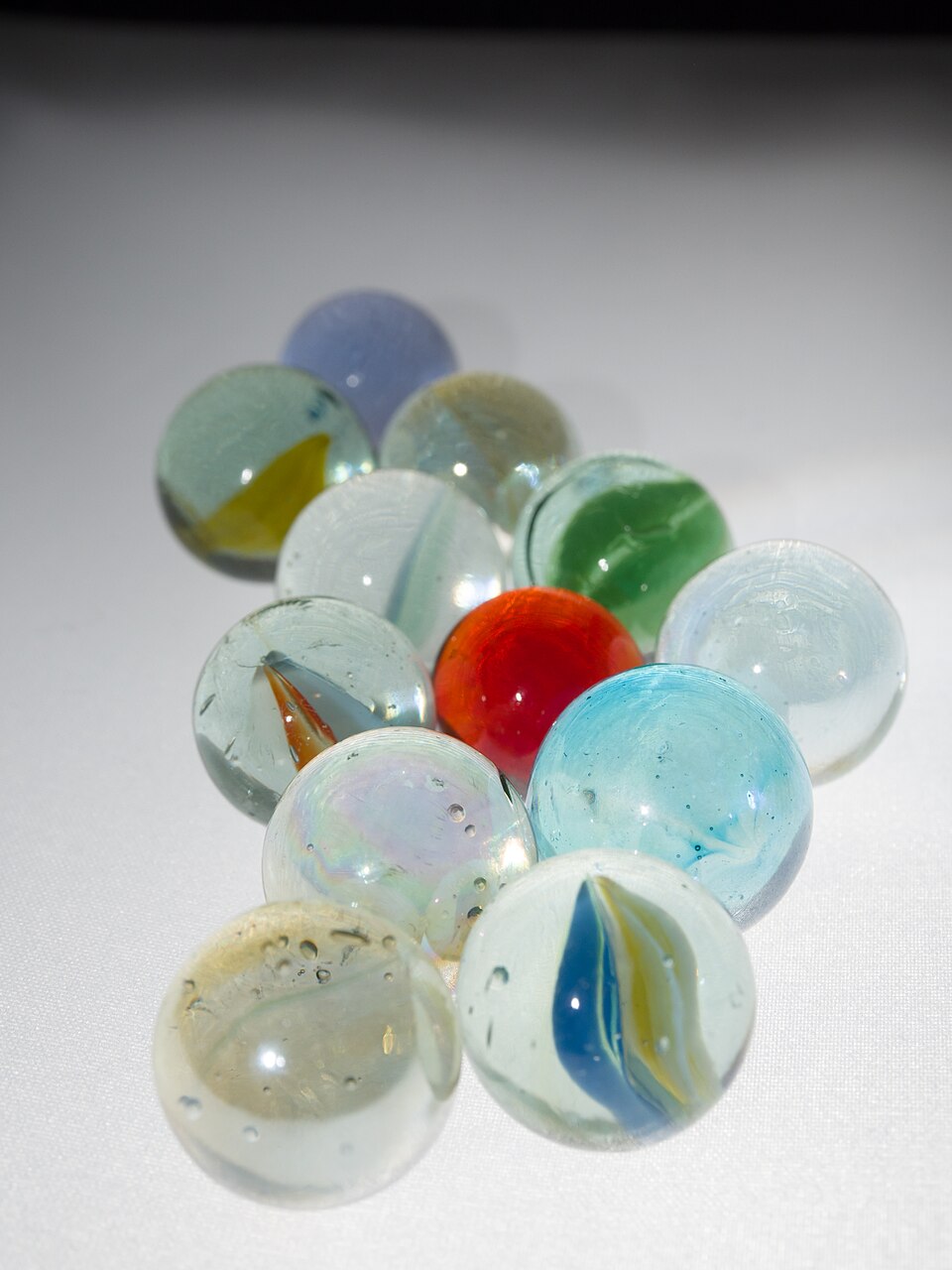 Rake light across the glass
Use angled light for chips, crescent bruises, haze, pinpricks, and polishing. Condition supports the price; it cannot rescue a vague identification.
Photo: James Petts, CC BY-SA 2.0, via Wikimedia Commons.
- Look for a pontil scar first: handmade vs. machine-made.
- Size matters: shooters over 1" earn a premium.
- Identify the maker pattern (Akro, Peltier, Christensen, Vitro).
- Rake with strong angled light: chips, moons, haze.
- Original box or mesh bag? Big bonus: price it separately.
- Modern cat's eyes? Only cheap, and only by the batch.
No pattern, bulk quantity, modern production.
Victory, Conqueror, All-Red, Tiger Eye, clean surface.
Corkscrews, oxblood, Rainbo, unusual colorways.
Guinea, flame, Superman, Christmas Tree.
Swirl, Lutz, sulphide, onionskin, visible pontil, large size, mint.
Akro boxes, Marble King headers, Christmas Tree boxes.
- Big chips, or moons everywhere.
- Hazy or "sick" glass, heavy pitting.
- Modern Vacor / JABO marbles priced as antiques.
- Plain no-pattern marbles at collector prices.
- Sulphides with a broken figure or cracked glass.
Link disclosure: eBay links currently open ordinary sold-search results. If a link becomes commission-earning in the future, it will be clearly identified near the link.
Questions collectors ask
Does a pontil prove that a marble is antique?
No. A pontil is a construction clue. Identify how it was formed, then compare the internal pattern, glass, size, surface, and known maker traits.
Can a polished marble still be collectible?
Yes, but polishing usually lowers demand because it removes original surface and can blur evidence of age or damage. Disclose it and compare with other polished examples.
Which photos help identify a vintage marble?
Use diffuse daylight, a plain background, several rotations, and one image beside a ruler or caliper. Add close views of pontils, chips, fractures, and unusual seams.
Criterion cards use real photographs with visible source and rights notes. Blocked pilots are local-only and cannot ship. Prices reflect eBay sold ranges as of July 2026.