Violins, horns, guitars · school cases and attic finds
Musical Instruments
The brand on the front is usually a store, a model line, or a tribute. The model number, the serial number, and the crack you have not found yet decide the price.
In 1918 Vincent Bach came out of the army and back onto New York theater stages as a trumpet soloist. The mouthpieces he could buy did not suit him, so he began cutting his own. Six years later he started designing horns. In 1925 he sold his first trumpets and stamped a name on the bell that belonged to a violin maker who had been dead for 188 years: Stradivarius, Model 1.

Act IThe label that started out honest
Antonio Stradivari worked in Cremona until his death in 1737 and made more than 1,100 instruments by current estimate, of which about 650 survive. Thousands more violins carry his name on a paper label glued inside the body, so the presence of that label has no bearing on whether the instrument is his work. In the nineteenth century this was not a con. The label named the model an inexpensive violin had been built around, and the buyer knew it. What got lost over a century was never the honesty. It was the receipt.
Act IIOne line on the label still tells the truth
Copies made after 1891 often carry a country of origin printed in English along the bottom edge, because United States rules on imported goods required the marking. So the paper reads Faciebat Anno 1721 in Latin, and half an inch below that it reads Made in Czechoslovakia, a country that did not exist until 1918. This is the cheapest trick in the category and almost nobody at a garage sale uses it. Bring a small flashlight, hold it at an angle through the f hole, and read the last line first.

Act IIIThe store that never built a guitar
Sears put the Silvertone name on a hand-cranked phonograph in 1915. By the 1930s it had replaced Supertone on the musical instruments, and it survived in the catalog until spring 1972. In all those years Sears built none of them. Danelectro, Harmony, Kay, Valco, Thomas and Teisco did, under contract, while selling nearly the same instruments under their own names. That is why the headstock and the soundhole disagree, and why the soundhole wins. The label inside carries the factory and a model number you can actually price.

Act IVSometimes the name is the answer, and sometimes it is two answers
Bach borrowed a name and then paid it back. A used 180S37 Stradivarius trumpet still trades around $1,180 to $2,363, against roughly $3,569 new. Hohner borrowed nothing: M. Hohner is stamped into the coverplate and printed on the lid. Then there is Selmer, one word covering two very different objects. Henri Selmer Paris, founded in Montmartre in 1885, built the Mark VI, and a 1960s tenor runs about $4,120 to $8,234. The Bundy line that reached American school band rooms under the same family name sits at $219 to $419 for an alto. Sellers title both of them Selmer saxophone.
Act VWhat the folding table actually asks
None of these names lie. They just answer a different question from the one being asked at the table. A brand tells you who sold the thing. The model number tells you what it actually is, and the serial number will usually get you somewhere near a year. Whether any of that matters gets settled elsewhere: by the crack in the top, by the pink bloom inside the lead pipe, by the pad gone hard and black. A repair quote on a common student horn routinely beats what the horn resells for. So pick it up and look through the f hole before you look at the headstock. Read the name last.
An exact model and serial, a body with no structural crack, clean valves or keys, honest playability, and the original case, mouthpiece or bow that makes it a complete working outfit.
Parents upgrading a school band student, community and church groups buying spares, repair technicians buying parts bodies, catalog-guitar players chasing a specific factory sound, and professionals shopping by model and serial.
Price the repair before the instrument. A sound post crack, a full repad, or a red rot lead pipe can cost more than the finished sale, and nothing about the brand name changes that arithmetic.
Sources: Smithsonian Institution: violins bearing a Stradivarius label · Bach Brass: history of Vincent Bach · Sears Archives: Silvertone, 1915-1972 · Wikipedia: Silvertone contract manufacturers · Henri Selmer Paris: company history · Reverb Price Guide: recorded sale prices
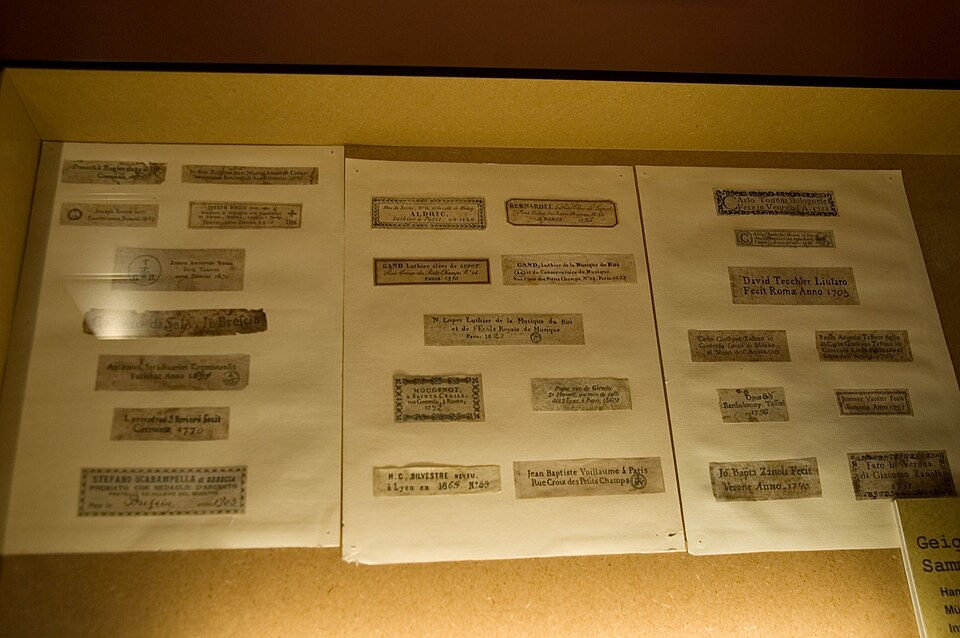 Violin: photograph every label line
Capture maker wording, date, and any country line in one sharp frame. A Stradivarius-style label is a clue to research, not proof of authorship.
Photo: Jennifer Pack, CC BY-SA 2.0, via Wikimedia Commons.
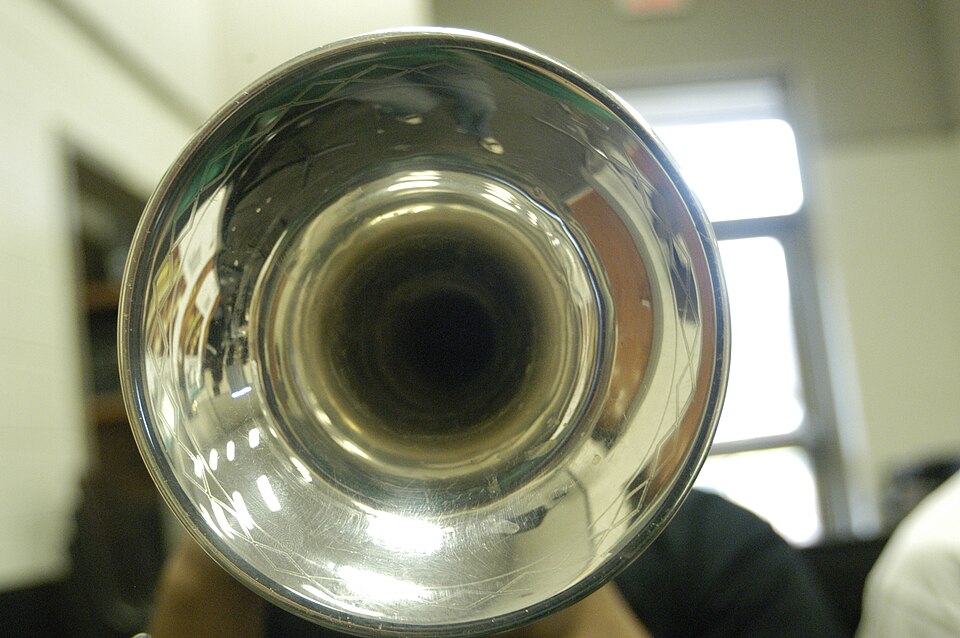 Brass: shoot the bell straight on
Use this angle for the complete maker and model engraving, then photograph the valve or receiver serial separately. Price only after both agree.
Photo: Gdk411, CC BY-SA 3.0, via Wikimedia Commons.
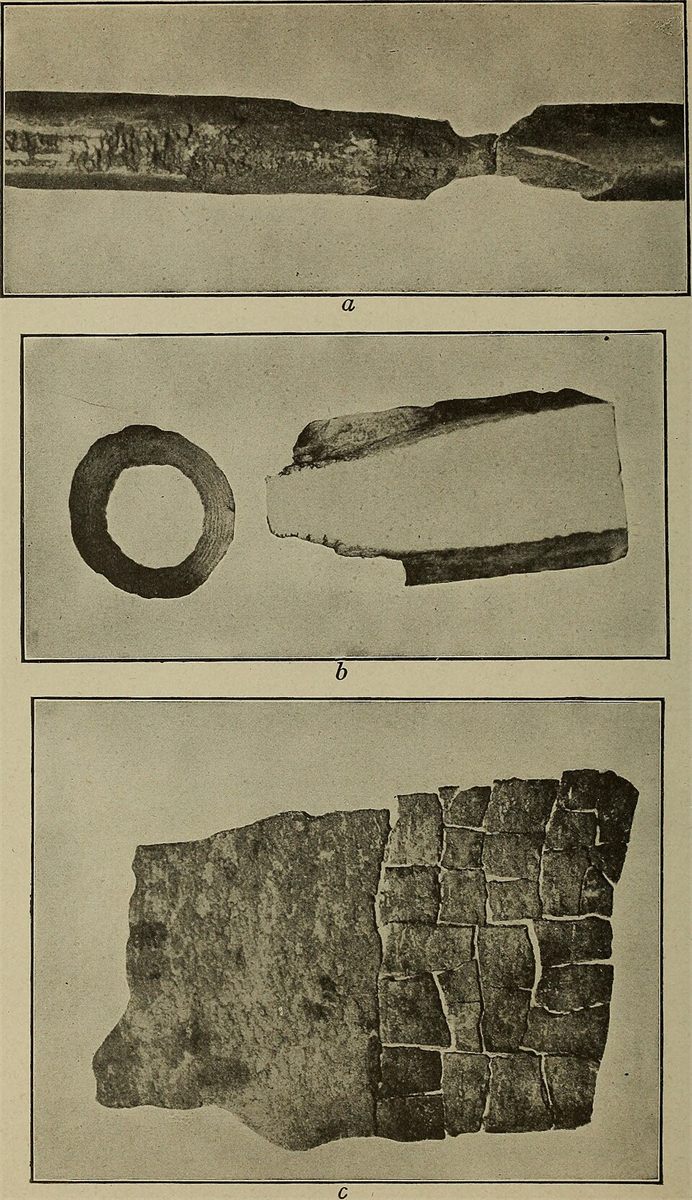 Brass: copper-red corrosion is structural
The attacked metal in these NIST specimens has lost zinc and turned copper-red. On an instrument, pink patches plus pinholes are not ordinary tarnish.
Image: H. S. Rawdon / NIST, public domain, via Wikimedia Commons.
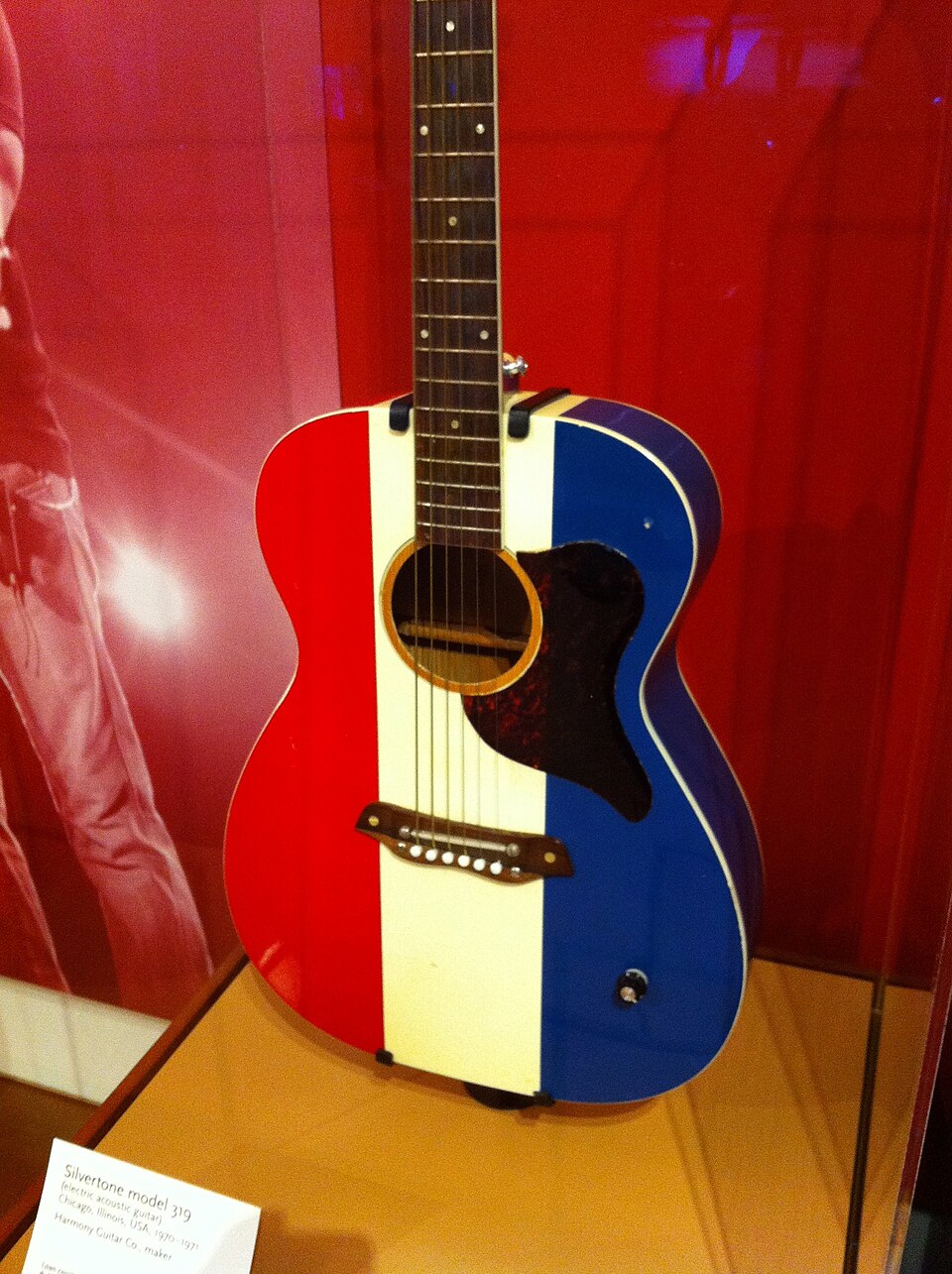 Guitar: pair the brand with the model
Silvertone was a retail name, so the headstock alone is incomplete evidence. Match it to the paper label or stamped number inside the soundhole.
Photo: Dave Fey / MIM, CC BY 2.0, via Wikimedia Commons.
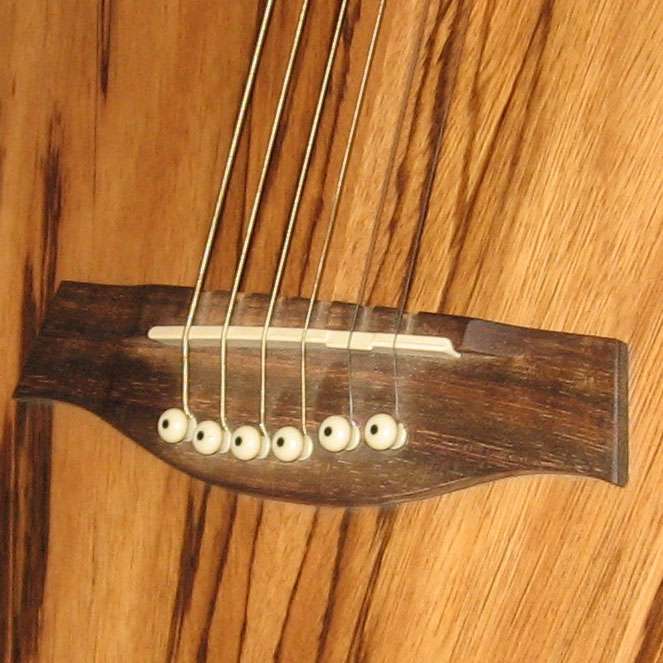 Guitar: the bridge must sit flat
Sight the neck, then light the rear edge of the bridge. Any opening seam or rising belly needs a repair allowance before you buy.
Photo: D.bratchuk, CC BY-SA 3.0, via Wikimedia Commons.
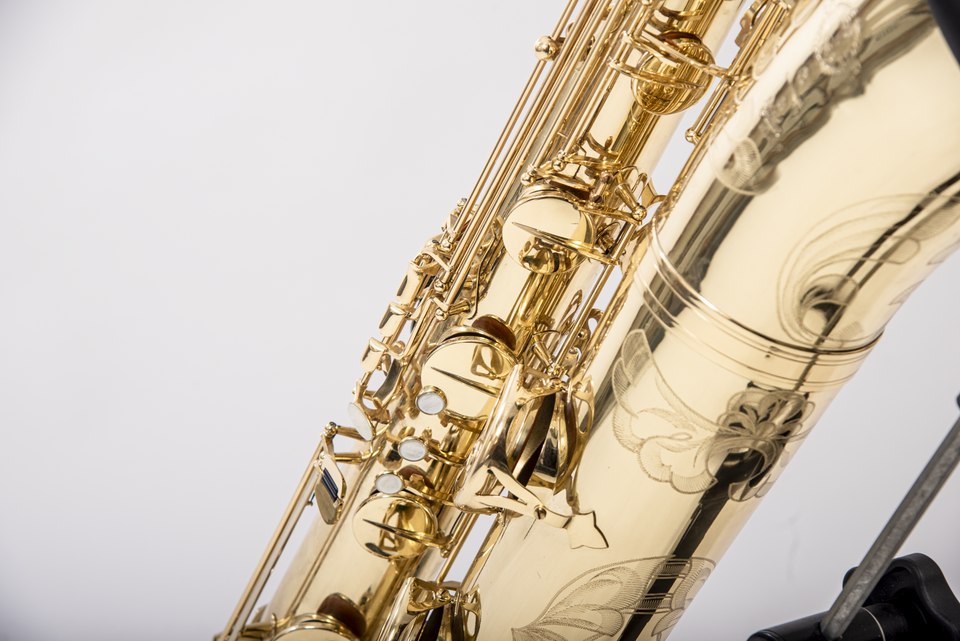 Woodwind: record the full engraving
Photograph every word and the complete serial. Selmer Paris professional engraving and a Bundy student mark belong to different markets.
Photo: Debbie Rawson, CC BY-SA 4.0, via Wikimedia Commons.
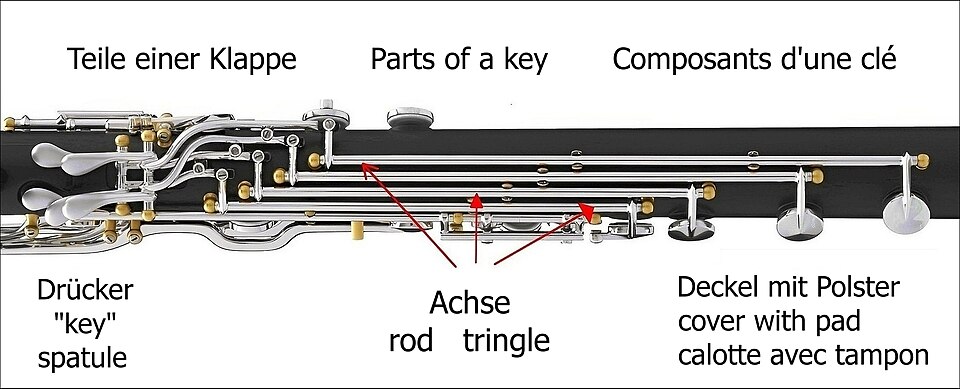 Woodwind: inspect the whole key train
Check pads, rods, springs, and corks in order. Hard pads, bent rods, or split corks can turn a named horn into a repair project.
Image: Schorle, CC BY-SA 4.0, via Wikimedia Commons.
- Find the model: bell engraving, soundhole label, or stamped number. Brand alone prices nothing.
- Find the serial: valve casing, saxophone body and neck, guitar headstock rear or neck heel.
- Light the label: angle a flashlight through the f hole and read the country line at the bottom.
- Hunt structural damage: top and body cracks, lifted bridges, separated necks, red rot, bent saxophone bodies.
- Make it move: press every valve and key, turn the pegs, watch the linkage return. Video beats photos here.
- Price the repair first: if a repad, a crack, or a lead pipe is in play, subtract that before you offer.
A top crack, a sound post crack, or a separating neck all need a shop before the instrument can be sold as playable.
No cracks, pegs that turn, fingerboard attached, bridge and sound post in place.
Value sits in the original box, early coverplate wording, and clean metal. Hygiene limits the buyer pool.
Uncracked body, complete keywork, pads not hardened, original case present.
Readable soundhole label or model number, straight neck, bridge sitting flat, no top cracks.
No red rot, no crushed bracing or perforated dents, valves moving freely, case and mouthpiece included.
Engraving and serial photographed clearly, body straight, no cracks, linkage working through the range.
- A crack runs through the top, body or neck joint, or the neck has separated from the block.
- Red rot has spread across the lead pipe or slides, or a dent has broken through the metal.
- A saxophone body is visibly bent, or the key linkage no longer closes across the range.
- Every pad on a common student horn is hard, cracked or missing and a full repad is the only path.
- The seller will not open the case, show the serial, or let you press the valves and keys.
- A Stradivarius label is being priced as an antique violin with no other evidence at all.
- Electronics and amplifiers cannot be powered up and tested, or a heavy piece is already close to resale before you carry it.
- Every piece of engraving, stamping and labeling: bell, headstock, soundhole label, and the paper label inside the violin lit at an angle.
- The serial number in place, plus a second shot wide enough to show which part of the instrument it sits on.
- Structural condition: body and top cracks, neck joints, lifted bridges, dents, solder repairs, and lead pipe interiors.
- Mechanism and wear: valves, keys, rods, corks, pads, pegs, tuners, plus a short video of everything that is supposed to move.
- The case interior and every accessory: mouthpiece, bow, bridge, ligature, reeds, paperwork and original packaging.
Link disclosure: eBay links currently open ordinary sold-search results. If a link becomes commission-earning in the future, it will be clearly identified near the link.
Questions collectors ask
Does a Stradivarius label mean a violin is valuable?
No. The label names the model an instrument was copied from, not its maker. A country of origin printed at the bottom marks a copy made after 1891 under United States import marking rules.
Who actually made Silvertone guitars?
Sears sold them under its own brand and contracted the building out. Danelectro, Harmony, Kay, Valco, Thomas and Teisco made them, so price the instrument by the model number inside the soundhole.
When is a cheap student band instrument not worth buying?
When repair cost passes resale value. A cracked body, a bent saxophone, red rot through a lead pipe, or a full repad on a common student horn usually costs more than the finished sale returns.
Price evidence checked July 27, 2026 against Reverb Price Guide estimated used values, which are drawn from recorded sales: Silvertone 1448 (1962-1967) $356-667, Harmony H1260 Sovereign $458-1,080, Bach 180S37 $1,180-2,363, Selmer Bundy II alto $219-419, and Selmer Mark VI tenor (1960-1969) $4,120-8,234. Those are resale figures, not buy prices. eBay completed listings could not be captured during this check, so the trade violin and harmonica tiers carry no marketplace sample and their ceilings are set conservatively. Reference photographs document collection objects and do not authenticate the instrument in your hands.